SECURITY · RESILIENCE · GOVERNANCE

Enterprise Cisco call recording trust should be built on evidence.

This Trust Center explains how call-recording.com handles Cisco call recording data, local and cloud encryption, delivery resilience, recorder fleet design, security boundaries, and regulated-deployment governance. It also makes clear which decisions require a deployment-specific design or contractual review.

ASSURANCE STATUS

Controls, architecture choices, and claims are not the same thing.

The table below separates what call-recording.com implements from what must be designed per customer and what should only be asserted when current evidence exists. That distinction matters in a bank, healthcare provider, contact center, public company, or any other organization where a marketing sentence cannot substitute for control validation.

Encrypted recording storage on the customer-hosted recorder and in the cloud

call-recording.com encrypts recording data at rest on the local recorder host before delivery. Recording objects stored by the service are encrypted at rest using AES-256, while transport to call-recording.com uses encrypted outbound communication.
IMPLEMENTED CONTROL

Crash-safe recording journal, durable outbox, retry, and receipt confirmation

A finished call is journaled before database enqueue, outstanding CDR and audio work remains visible to the delivery process, failed attempts back off and retry, and local completion waits for confirmed backend receipt.

IMPLEMENTED CONTROL

No inbound internet path to the recorder

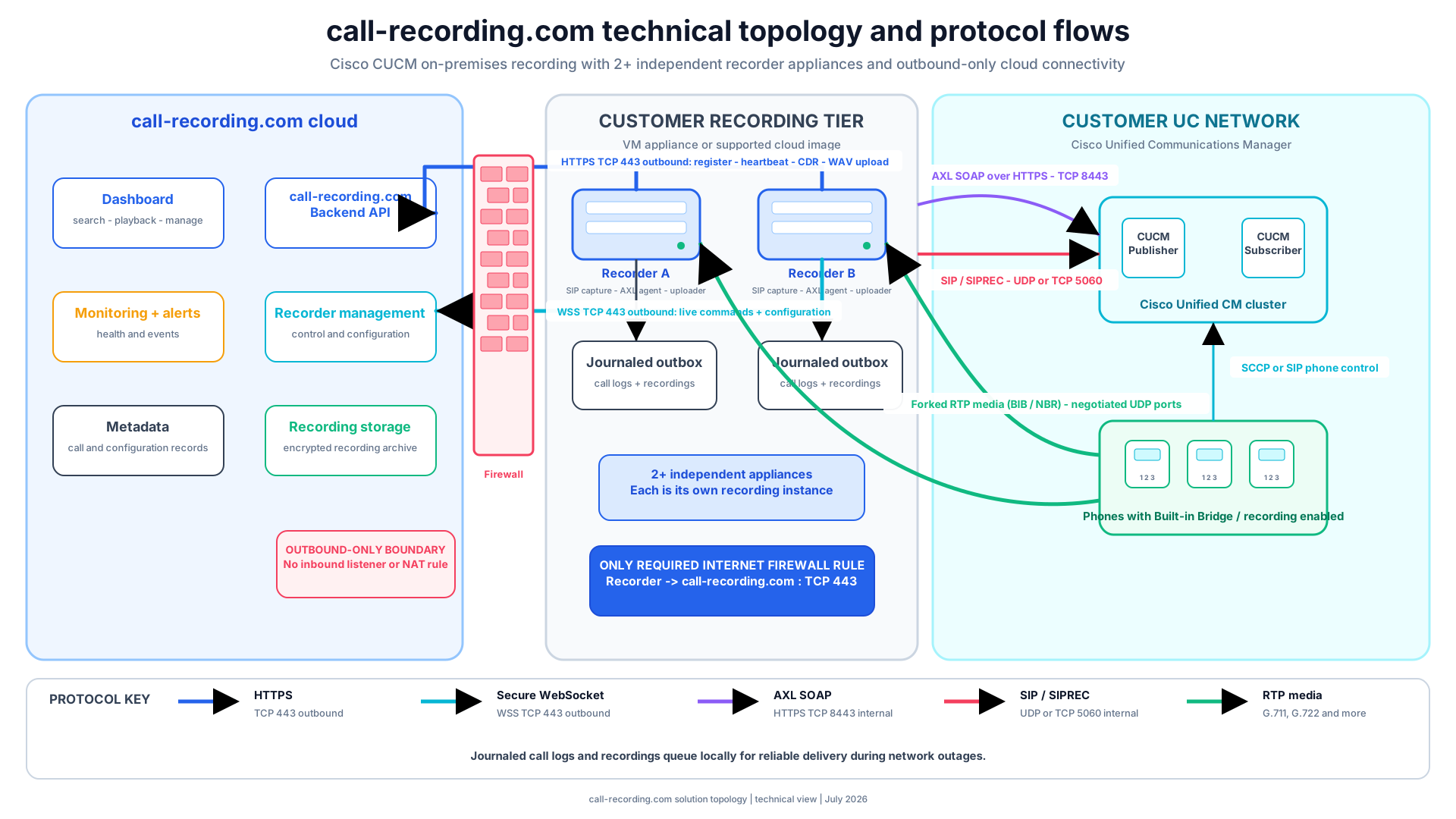
The recorder initiates its call-recording.com control and delivery path outbound. No public recorder administration portal, inbound internet listener, or port-forwarding rule is required. Internal Cisco signaling and media paths remain inside the customer environment.

IMPLEMENTED CONTROL

Organization-scoped identity, recorder health, and fleet visibility

Authenticated access is scoped to the customer organization. Recorder instances report health, service state, active-call and pending-outbox telemetry so administrators can see capture and delivery conditions instead of discovering a gap later.

IMPLEMENTED CONTROL

Multi-site recorder placement, capacity, HA, and recovery objectives

The service supports multiple independently managed recorder instances. Site placement, Cisco media anchoring, load distribution, duplicate capture, recovery point and recovery time objectives, and failure-domain testing must be designed around the customer topology.

DEPLOYMENT-SCOPED

Certifications, audit reports, uptime SLAs, and named customer references

call-recording.com will not publish a badge, service level, scale number, or customer endorsement unless its scope, date, permission, and supporting evidence can be verified. Request the current assurance package and contractual commitments during evaluation.

EVIDENCE REQUIRED

CISCO RECORDING DATA FLOW

Four boundaries. One accountable path.

The recorder stays close to Cisco Unified Communications Manager or Cisco CUBE. Cloud delivery is a separate, observable stage, which is why a WAN interruption does not have to become a lost call recording.

Open the full technical topology
  1. 01

    Cisco call capture

    CUCM phone-based recording, network-based recording, or Cisco CUBE SIPREC sends the authorized signaling and media required for recording to a recorder inside the customer-controlled environment.

    CUSTOMER VOICE NETWORK
  2. 02

    Encrypted local persistence

    The recorder captures and processes the call, encrypts recording data at rest on the recorder host, writes crash-safe journal state, and tracks pending CDR and recording work in its durable outbox.

    CUSTOMER RECORDER HOST
  3. 03

    Outbound encrypted delivery

    The recorder initiates the management and upload connection to call-recording.com. Delivery retries after interruption and remains pending until the backend confirms the CDR and recording lifecycle.

    OUTBOUND HTTPS / WSS
  4. 04

    Organization-scoped cloud access

    Stored recordings and metadata are encrypted at rest. Authenticated users access recordings through organization-scoped dashboard workflows, with retention and administrative controls applied to the customer account.

    CALL-RECORDING.COM CLOUD
call-recording.com technical security topology SVG · PDF · VISIO AVAILABLE
Technical Cisco call recording data-flow diagram showing CUCM, phones, the customer-hosted recorder, internal SIP and RTP, and outbound encrypted delivery to call-recording.com.

RESILIENCE, HA & DR

Define the failure first. Then prove the recovery.

High availability is not a single feature switch. A serious call recording design considers the phone or gateway media source, CUCM or CUBE, recorder process, recorder host, site, WAN, cloud control plane, storage, identity, and operator response as separate failure domains.

WAN or cloud interruption

Capture continues at the customer-hosted recorder. Encrypted local persistence, journal reconciliation, durable retry, and backend confirmation protect work until connectivity returns.

Recorder or site failure

Multiple recorder instances can be managed within an organization and placed around site or call-control boundaries. Whether calls are duplicated, redistributed, or unavailable depends on the Cisco design and must be tested.

Operational detection

Recorder heartbeats expose service health, active calls, disk and outbox state. Administrators can monitor recorder availability and pending delivery rather than treating silence as success.

What call-recording.com does not collapse into a marketing promise

Journaled delivery protects a recording after it reaches the recorder; it cannot capture media a failed phone, gateway, CUCM service, recorder host, or network path never delivered. An enterprise design should document call flows, failure domains, recorder placement, capacity headroom, alert ownership, recovery objectives, and validation calls for every required scenario.

REGULATED DEPLOYMENT GOVERNANCE

Controls support compliance. They do not replace it.

A regulated call recording program combines law, policy, Cisco configuration, technical controls, supervision, retention, incident response, vendor governance, and evidence. call-recording.com can supply recording and delivery controls; the customer remains responsible for deciding what must be recorded and how the system is governed.

01

Lawful scope and disclosure

Document jurisdictions, lawful basis, employee and customer notice, disclosure tones or announcements, and exceptions.

02

Recording completeness

Define required users and call types, excluded flows, pause and resume behavior, test cases, monitoring, and escalation ownership.

03

Retention and legal hold

Map record categories to retention periods, deletion workflows, litigation or investigation holds, and approval evidence.

04

Access and accountability

Limit access by role and organization, review administrative privileges, control exports, and preserve evidence of material actions.

05

Vendor and change governance

Review release scope, support paths, dependencies, end-of-life risks, recovery procedures, and material architecture changes.

06

Periodic validation

Test capture, playback, metadata, disclosure, outage recovery, recorder restart, retention, deletion, and incident-response procedures.

TRUST CENTER FAQ

Questions an enterprise review should ask.

Is call-recording.com suitable for regulated Cisco call recording?

call-recording.com provides technical controls that can support a regulated recording program, including customer-hosted Cisco call capture, encryption at rest on the recorder host and in cloud storage, authenticated organization-scoped access, durable delivery, retention controls, and health telemetry. Suitability still depends on the organization, jurisdiction, configuration, contracts, and control testing. The service does not turn a customer into a compliant organization by itself.

How does call-recording.com protect calls during an internet outage?

The customer-hosted recorder separates call capture from cloud delivery. Completed work is persisted locally, written to a crash-safe journal, entered in a durable outbox, retried after connectivity returns, and retained until the backend confirms receipt. This protects captured calls from a temporary WAN or cloud interruption.

Does the Cisco recording server require inbound internet access?

No inbound internet connection or port forwarding is required for the call-recording.com recorder. The recorder communicates with the Cisco voice systems it serves on the customer network and initiates its encrypted management and delivery connection outbound to call-recording.com.

How does call-recording.com approach high availability and disaster recovery?

The design addresses distinct failure domains instead of treating HA as one vague claim. Local encrypted persistence and journaled retry protect captured work during WAN interruptions and process restarts. Organizations can place independently managed recorder instances at separate sites or call-control domains. Capacity, duplicate capture, recovery objectives, and any contractual service commitments must be designed and validated for the specific deployment.

Which security certifications does call-recording.com hold?

call-recording.com publishes only certifications, audit reports, service levels, and contractual commitments that are current and can be supported by evidence. This public Trust Center does not use unverified certification badges or imply a universal certification scope. Organizations should request the current assurance package during their security review.

PUT THE CLAIMS THROUGH YOUR PROCESS

Evaluate call-recording.com with your Cisco calls and your failure scenarios.

Download the evidence pack, validate the architecture, then use a trial to test capture, local encryption, recorder restarts, WAN interruption, retry, confirmed delivery, access, retention, and monitoring in the environment that matters.