Privacy compliance field guide
GDPR and Its Implications for Call Recording Requirements
A controller-focused guide to the GDPR questions behind every recording program—from lawful basis and notice to retention, security, data-subject rights, and international transfers.
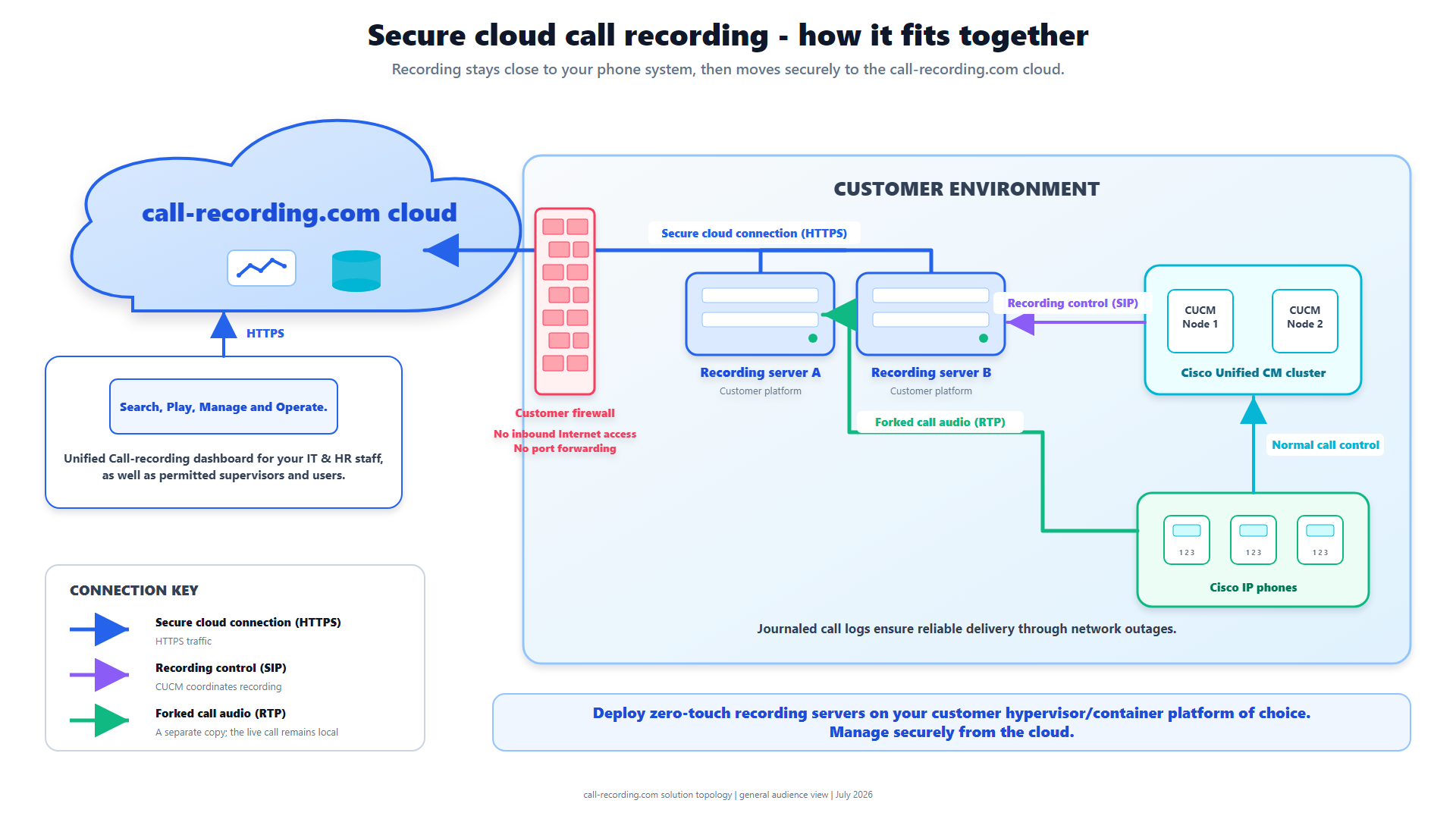
Signal path
Where call-recording.com intervenes
From technical requirement to working recording
call-recording.com helps organizations operationalize a documented recording policy with scoped access, configurable retention, encrypted storage, searchable retrieval, and Cisco-focused deployment controls.
Does the GDPR allow call recording?
Yes. The General Data Protection Regulation does not prohibit business call recording. It requires the organization responsible for the recording—the controller—to have a lawful, fair, transparent, necessary, and secure reason for processing the personal data in the call.
The practical question is not “Does GDPR require consent for every recording?” It is “Which lawful basis applies to this specific purpose, and can the organization demonstrate that every part of the recording lifecycle follows the GDPR principles?”
This guide is general operational information, not legal advice. EU Member State laws, employment rules, telecommunications secrecy, sector regulation, and the ePrivacy framework may add obligations beyond the GDPR.
A call recording is personal data
A recording may contain a voice, name, phone number, account information, opinions, transaction instructions, health details, payment information, and information about employees or third parties. The audio, call metadata, transcript, notes, tags, and access logs can all be personal data.
If a recording reveals special-category information—such as health, political opinions, religion, trade-union membership, biometric identification, sex life, or sexual orientation—Article 9 conditions may also apply. The fact that the business did not ask for sensitive information does not mean the caller cannot say it.
This is why call-recording.com treats the recording as protected data from capture through storage and access.
Choose and document the lawful basis
Article 6 lists six lawful bases: consent, contract, legal obligation, vital interests, public task, and legitimate interests. Several can be relevant to call recording, but the controller should identify the appropriate basis before recording and should not switch bases casually after the fact.
Examples include:
- Legal obligation: a regulated firm records specified communications because binding law requires it.
- Contract: recording is objectively necessary to perform or enter a contract, not merely useful to the business.
- Legitimate interests: the controller identifies a lawful, real interest, proves recording is necessary, and balances that interest against the individual’s rights and reasonable expectations.
- Consent: the individual receives a genuine, informed choice and can withdraw without detriment; this may be difficult in employment or essential-service contexts because of power imbalance.
The European Data Protection Board describes a three-part legitimate-interest test: purpose, necessity, and balancing. A generic statement that “calls are recorded for quality” is not the test.
Transparency and recording notices
Articles 13 and 14 require clear information about processing. A short recorded announcement can provide immediate notice, but it rarely contains the complete privacy information.
A layered notice can state at the beginning of the call that recording occurs and why, then direct the caller to a privacy notice covering:
- controller identity and contact information;
- specific recording purposes;
- lawful basis and legitimate interests, where used;
- recipients and service providers;
- international transfers and safeguards;
- retention period or criteria;
- data-subject rights;
- complaint rights;
- whether recording is mandatory and what happens if the caller objects;
- automated decision-making, transcription, or analytics where applicable.
Cisco CUCM supports recording notification tones, and a business can also use announcements in the call-routing path. Read the Cisco Built-In Bridge guide for the interaction between BIB recording and notification settings.
Purpose limitation and data minimization
Article 5 requires specified purposes and data minimization. “Record everything because storage is cheap” is weak governance.
Ask:
- Which call types actually need audio?
- Could CDR metadata, a transaction confirmation, or targeted monitoring meet the purpose?
- Should personal calls, internal calls, or sensitive queues be excluded?
- Can recording pause for payment-card entry or other sensitive moments?
- Which users need playback rather than aggregate reporting?
- Is transcription necessary, or does it create a larger searchable personal-data set?
call-recording.com supports a defined Cisco recording population rather than forcing one global policy. The technical design should mirror the documented purpose.
Retention: keep recordings only as long as necessary
The GDPR does not prescribe one universal call-recording retention period. The controller sets a period based on purpose, legal requirements, limitation periods, complaints, evidence needs, and risk.
Different purposes may require different schedules. Training samples may need weeks or months; regulated transaction records may need a statutory period; an active dispute may require legal hold. Once the purpose ends and no other lawful requirement applies, storage limitation points toward deletion.
Use call-recording.com retention controls to implement an approved schedule. Do not use configurable retention as a substitute for deciding what the schedule should be.
Security under Article 32
Article 32 requires measures appropriate to risk, considering confidentiality, integrity, availability, resilience, restoration, and regular testing. For call recording, that translates into concrete controls:
- encrypted storage on the local recorder host;
- encrypted recording storage in the cloud;
- protected transport for management and delivery;
- organization-scoped authentication and authorization;
- least-privilege playback, download, deletion, and administration;
- durable recording delivery through network interruptions;
- backups and recovery appropriate to the service;
- logging, monitoring, incident response, and periodic testing;
- recorder-host hardening and patch management.
The call-recording.com security architecture minimizes network exposure with customer-hosted capture and outbound HTTPS communication. The recording integrity design addresses availability with local persistence, journaling, retries, and confirmation-driven upload.
No time to waste translating raw call detail records? Use Call Recordings FREE tool below!
CDR Clarity
Free from call-recording.com
The smarter way to view Call Records
Our free tool decodes Cisco CUCM call records into plain language and displays them in a beautiful "spreadsheet" inspired UI.
Open free CDR viewerData-subject rights and recordings
Individuals may have rights of access, rectification, erasure, restriction, portability, and objection depending on the lawful basis and circumstances. A recording can involve more than one person, so responding may require balancing the requester’s access with other people’s rights.
Operational readiness means the business can:
- search by reliable identity and date criteria;
- locate related audio and metadata;
- confirm the purpose and retention state;
- securely export an appropriate copy;
- redact or otherwise protect third-party information where required;
- preserve a legal hold;
- document an exemption or refusal;
- complete deletion across applicable systems when required.
Searchable recordings and stable call details make this far easier than a folder of filenames. That is a core reason to use call-recording.com rather than unmanaged local audio.
Employee call recording
Employee monitoring raises additional fairness and proportionality concerns because workers may have limited choice. The UK ICO’s guidance—relevant directly to UK GDPR and useful as a practical benchmark—states that routine content recording is not usually proportionate in every case and that workers and callers should be informed.
An employee recording program should define:
- the business purpose and lawful basis;
- the workers and call types included;
- whether personal calls are excluded;
- who can monitor live or review recordings;
- whether recordings influence performance or disciplinary decisions;
- how remote-work privacy is handled;
- training, policy acknowledgment, and consultation requirements;
- retention and data-subject request procedures.
The workplace messaging guide extends the same governance questions to chat and collaboration channels.
DPIAs and high-risk processing
Article 35 requires a Data Protection Impact Assessment when processing is likely to result in high risk. Large-scale systematic monitoring, employee surveillance, sensitive calls, automated analysis, or combining recordings with other datasets can trigger the need for a DPIA.
A useful call-recording DPIA maps:
- data flows from Cisco endpoint or CUBE to recorder and cloud;
- people, data categories, purposes, and lawful bases;
- necessity and proportionality;
- caller and employee expectations;
- access, disclosure, transfer, retention, and deletion;
- security and availability controls;
- risks to individuals;
- mitigations, owners, and residual risk;
- consultation with the DPO and supervisory authority where required.
The technical call-recording topology in the Trust Center can help teams document the system boundary.
Controllers, processors, and international transfers
The customer normally determines why and which calls are recorded and is therefore the controller for that processing. A recording platform generally acts as a processor for the hosted service, although exact roles depend on the activity.
Article 28 requires appropriate processor terms. The controller should understand subprocessors, confidentiality, security, assistance with rights, breach notification, deletion/return, and audit information.
If personal data moves outside the EEA, the controller must identify the transfer mechanism under Chapter V—such as an adequacy decision or appropriate safeguards—and assess supplementary measures where necessary.
How call-recording.com supports a GDPR program
call-recording.com helps implement the technical side of the controller’s documented policy:
| GDPR objective | call-recording.com capability |
|---|---|
| Defined recording population | Cisco-focused guided provisioning and recording policy |
| Confidentiality | Encrypted local and cloud storage with scoped access |
| Availability and resilience | Local persistence, journaling, durable retries, confirmed delivery |
| Storage limitation | Configurable recording retention |
| Access and retrieval | Searchable recordings and call details |
| Data-flow clarity | Customer-hosted capture with outbound cloud delivery |
| Accountability | Observable recorder and delivery workflow |
These capabilities support compliance; they do not choose the lawful basis, write the privacy notice, or decide whether a specific call should be recorded.
GDPR call recording checklist
- Define each recording purpose.
- Select and document the Article 6 lawful basis.
- Assess Article 9 special-category conditions where relevant.
- Check Member State, employment, telecom, ePrivacy, and sector rules.
- Give callers and workers clear, timely notice.
- Record only the necessary users, lines, and call types.
- Set purpose-based retention and legal-hold rules.
- Restrict playback, export, deletion, and administration.
- Encrypt recordings locally, in transit, and in cloud storage.
- Prepare for access, objection, erasure, and restriction requests.
- Document processors and international-transfer safeguards.
- Complete a DPIA where risk requires it.
- Test outage recovery, deletion, incident response, and access controls.
- Review the program when purposes, analytics, vendors, or call flows change.
For businesses on Cisco telephony, call-recording.com provides the recording platform and controls needed to put that checklist into operation without turning CUCM recording into a long integration project. Compare GDPR with the separate HIPAA and MiFID II call-recording requirements before applying one policy to every regulated call.
Still struggling to decipher your call detail records? Try our user friendly tool!
CDR Clarity
Free from call-recording.com
The smarter way to view Call Records
Our free tool decodes Cisco CUCM call records into plain language and displays them in a beautiful "spreadsheet" inspired UI.
Open free CDR viewerWhere call-recording.com intervenes
From technical requirement to working recording
call-recording.com helps organizations operationalize a documented recording policy with scoped access, configurable retention, encrypted storage, searchable retrieval, and Cisco-focused deployment controls.
Source ledger
Primary references and technical evidence
Validate version-specific commands, legal scope, and policy decisions against the current source applicable to your environment.
Legal and compliance content is general information, not legal advice. Cisco behavior and commands vary by product release, platform, firmware, and call flow.
Continue the research