AI compliance analytics
Detect PII, Bullying, and Regulated Financial Communications with AI Analytics
The three permanent risk searches in call-recording.com, what each finding preserves, and how evidence from any platform moves from detection to authorized human review.
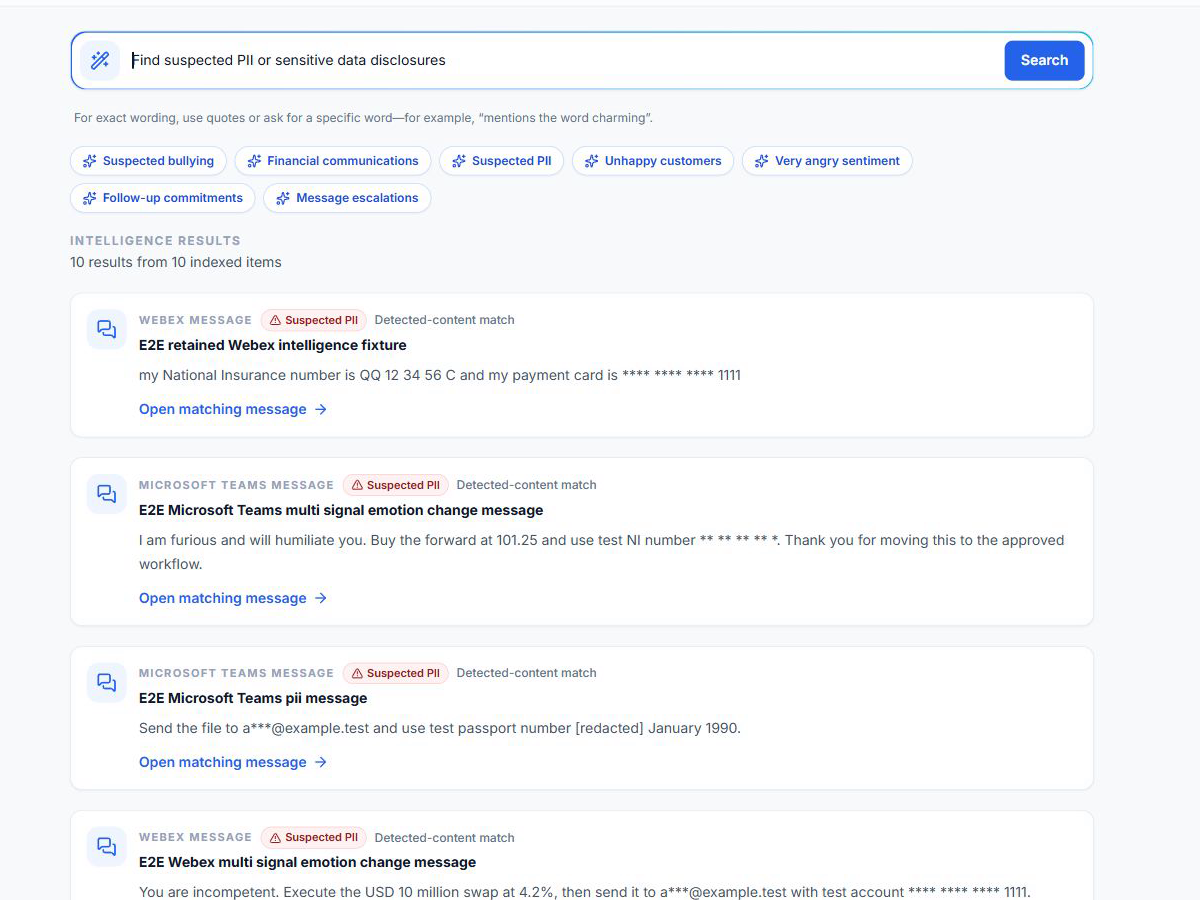
Dashboard screenshot
Live dashboard view: permanent PII, bullying, and financial-communications searches with masked, source-linked Webex and Microsoft Teams findings.
Signal path
Product fit
Where call-recording.com fits
call-recording.com analyzes authorized calls and messages from every integration, masks detected PII, and prioritizes conduct and financial-communications findings. Each finding keeps its channel, time, confidence, rationale, censored evidence, and source context together for review.
Compliance teams rarely struggle because they have too little communication data. They struggle because calls, meetings, transcripts, chats, and channel messages sit in separate systems with different search tools and review workflows. call-recording.com AI Analytics turns that fragmented archive into one evidence-led review surface for written and spoken communications.
The feature analyzes cross-platform calls and messages for suspected personally identifiable information (PII), bullying or harassment, and narrowly defined regulated financial communications. It then connects each signal to the source, the relevant moment, and the context a human reviewer needs.
Unify communication compliance capture
A modern Digital Communications Governance and Archiving (DCGA) program must follow a conversation across unified communications and collaboration tools. A customer call may continue in a team channel. A trading instruction may begin in chat and conclude by phone. A workplace concern may surface in a meeting, a direct message, and a later call.
The call-recording.com integration layer connects to existing eComms and aComms systems as an archive connector and reconciles what it collects. Captured sources are normalized without erasing their platform, participant, conversation, or timing identity. Current-version reconciliation ensures that search and review use the latest retained analysis instead of stale results.
Cover the platforms where work happens
Coverage starts with Cisco CUCM and Cisco Webex and extends across 23 dedicated integration Workers: 8x8, Aircall, Amazon Connect, Dialpad, Discord, Five9, Genesys Cloud, GoTo Connect, Google Workspace, Intercom, JustCall, Mattermost, Microsoft Teams, NICE CXone, OpenPhone, RingCentral, Rocket.Chat, Slack, Talkdesk, Twilio, Vonage, Zendesk, and Zoom.
The value of that breadth is practical: a compliance policy can follow the business conversation across calling, contact-center, meeting, messaging, and collaboration systems. See the wider workplace messaging capture model and the compliance recording and retention guide for governance and retention planning.
Support calls, messages, transcripts, and original context
Voice and video recordings remain connected to their transcripts, while message records retain conversation and sender context. Archives can also preserve the surrounding files, images, and other attachments needed to understand a communication. AI findings described here are grounded in message text and speech transcripts; the original source remains available for authorized review.
The distinction matters. A model-generated signal does not replace the record; it indexes it, helping reviewers move from a large capture estate to the exact call channel, message, or transcript passage that needs attention.
Detect PII with ML and deterministic validation
PII detection combines machine-learning analysis with deterministic validation. The system looks for suspected email addresses, telephone numbers, government identifiers such as Social Security numbers, and payment-card numbers. Deterministic patterns strengthen coverage for structured identifiers, while ML can recognize sensitive disclosure in conversational context.
Each PII finding is stored as a first-class detection rather than a generic tag. It carries its subject, platform, source segment, channel when available, time range, confidence, rationale, and bounded evidence excerpt. That structure makes the result searchable and reviewable across both calls and messages.
Mask sensitive evidence before it travels
Finding PII should not create a second disclosure. call-recording.com masks supported identifiers before evidence reaches reviewer-facing markers and notifications. Email, phone, government-ID, and payment-card evidence is reduced to a censored form that helps an authorized reviewer understand why a signal fired without repeating the full value.
The same principle applies to notification delivery: a concise censored excerpt can identify the incident, while a deep link takes the reviewer back to the controlled source. This supports faster triage and data minimization together.
Find suspected bullying and harassment
The bullying signal looks for targeted humiliation, harassment, intimidation, threats, coercion, or degrading conduct. It is designed for investigation triage across calls and workplace messages, including repeated conduct that becomes clear only when a reviewer reconstructs a timeline.
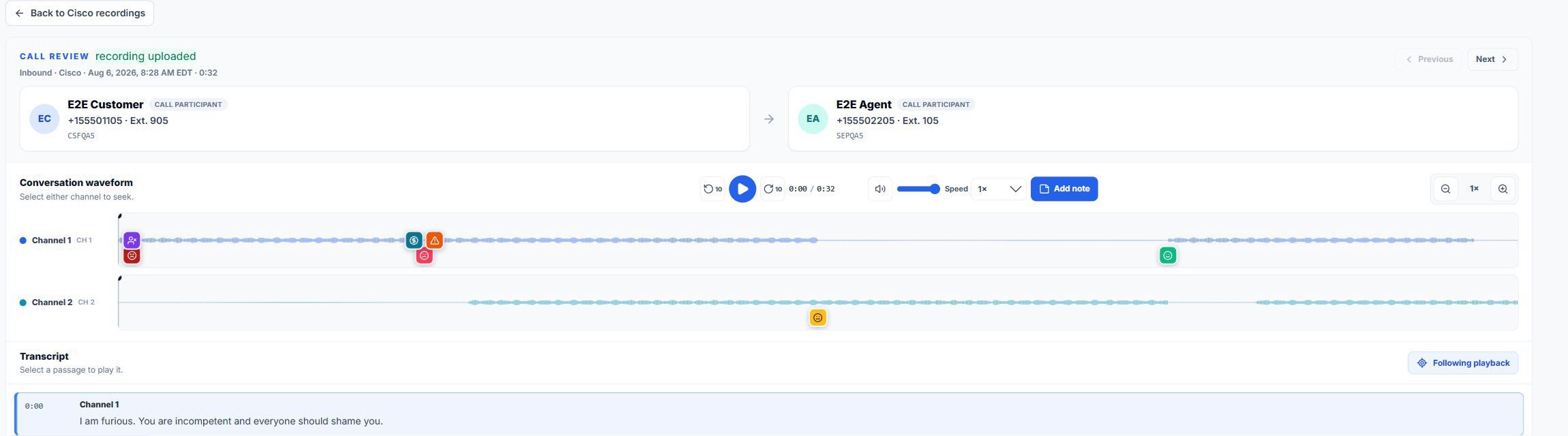
Signals appear as message badges or timestamped waveform markers. A reviewer can inspect the cited excerpt, confidence, rationale, speaker channel, and surrounding conversation instead of relying on a detached score. For a UK-focused investigation workflow, read AI analytics for workplace bullying and respect-at-work investigations.
Identify regulated financial communication signals
Financial detection is deliberately narrower than searching for any mention of money. It targets communications potentially relevant to 17 CFR § 23.202: quotes, solicitations, bids, offers, instructions, trading, and prices that lead to execution of a swap or conclusion of a related cash or forward transaction.
This scope avoids treating an ordinary invoice, refund, consumer payment, or budget discussion as a regulated-trade signal. The goal is better search coverage for trade reconstruction, not a generic financial-keyword alarm. The Dodd-Frank call-recording guide explains the underlying recordkeeping context.
Navigate a unified conversation timeline
On call recordings, suspected PII, bullying, and financial signals appear at the relevant point on dual-channel waveforms. Emotion changes use separate happy, neutral, unhappy, and angry markers for each channel. Notes can be added at a timestamp and reopened from the waveform or compact notes menu.
Playback, skip, volume, speed, zoom, transcript following, and previous-or-next navigation stay in the same workbench. Clicking a marker or transcript passage seeks directly to that moment. This unified conversation view reduces the time spent moving between an alert, a player, a transcript, and a notes system.
Search by meaning, wording, and stored detections
Conversation Intelligence combines semantic, lexical, exact-word, sentiment, and detection-aware retrieval. A reviewer can search for an idea expressed in different words, require a literal phrase, or retrieve stored PII, bullying, or financial findings without asking a semantic model to guess the category again.
Permanent search shortcuts make those review queues visible. Results preserve platform, source type, timecode, confidence, category, and a censored excerpt. The detailed AI search guide shows how exact and meaning-based searches answer different questions.
Move from passive archive to proactive compliance
Per-user notifications cover analysis started, completed, failed, and each detection category. Alerts identify the platform and source type, use a friendly event time, show available participant or conversation context, summarize the finding count, and link directly to the authorized call or message.
Organizations can choose dashboard and email delivery separately. That makes the archive operational: high-priority PII or bullying findings can reach a reviewer quickly, while lower-priority events remain available in the notification panel and search queues.
Preserve audit and explainability evidence
Every analysis has provenance: version and model identity, workflow and job state, processing stage, timestamps, source identity, and current-result promotion. Every finding adds source linkage, channel and time, confidence, rationale, and censored evidence. Notifications preserve their event type, destination preference, source link, and deduplication identity.
Together these records support explainability review and audit reporting for ML and AI systems. A team can show what the system surfaced, why it surfaced it, which source supported it, and what an authorized reviewer examined.
Keep people responsible for the conclusion
AI analytics should accelerate review, not make an employment, regulatory, or disciplinary decision by itself. Confidence is a prioritization aid. Emotion is context, not proof. A suspected-content marker points to evidence; it does not replace policy, legal scope, surrounding conversation, or a documented human conclusion.
That reviewer-centered design saves time for compliance and operations teams alike: people spend less time hunting for the right source, and the final judgment stays with those who can weigh context.
Build one review layer across the archive
The practical outcome is a single route from capture to action: unify communications, reconcile current sources, analyze calls and messages, detect priority risks, mask sensitive excerpts, search every authorized channel, navigate the original timeline, and preserve an explainable review trail.
That route connects Conversation Intelligence, accountable recording integrity, the security architecture, and flexible recorder deployment so capture, analysis, access, and review remain part of one system.
Explore AI Analytics to see how call-recording.com widens compliance search and speeds up review across the communications platforms your organization already uses.
Product fit
Where call-recording.com fits
call-recording.com analyzes authorized calls and messages from every integration, masks detected PII, and prioritizes conduct and financial-communications findings. Each finding keeps its channel, time, confidence, rationale, censored evidence, and source context together for review.
Sources
Primary references and technical evidence
Check commands, legal scope, and policy decisions against the current version of each source for your environment.
Legal and compliance content is general information, not legal advice. Cisco behavior and commands vary by release, platform, firmware, and call flow.
Keep reading