Conversation intelligence
Search Calls and Messages with AI: Sentiment, Transcripts, and Exact Words
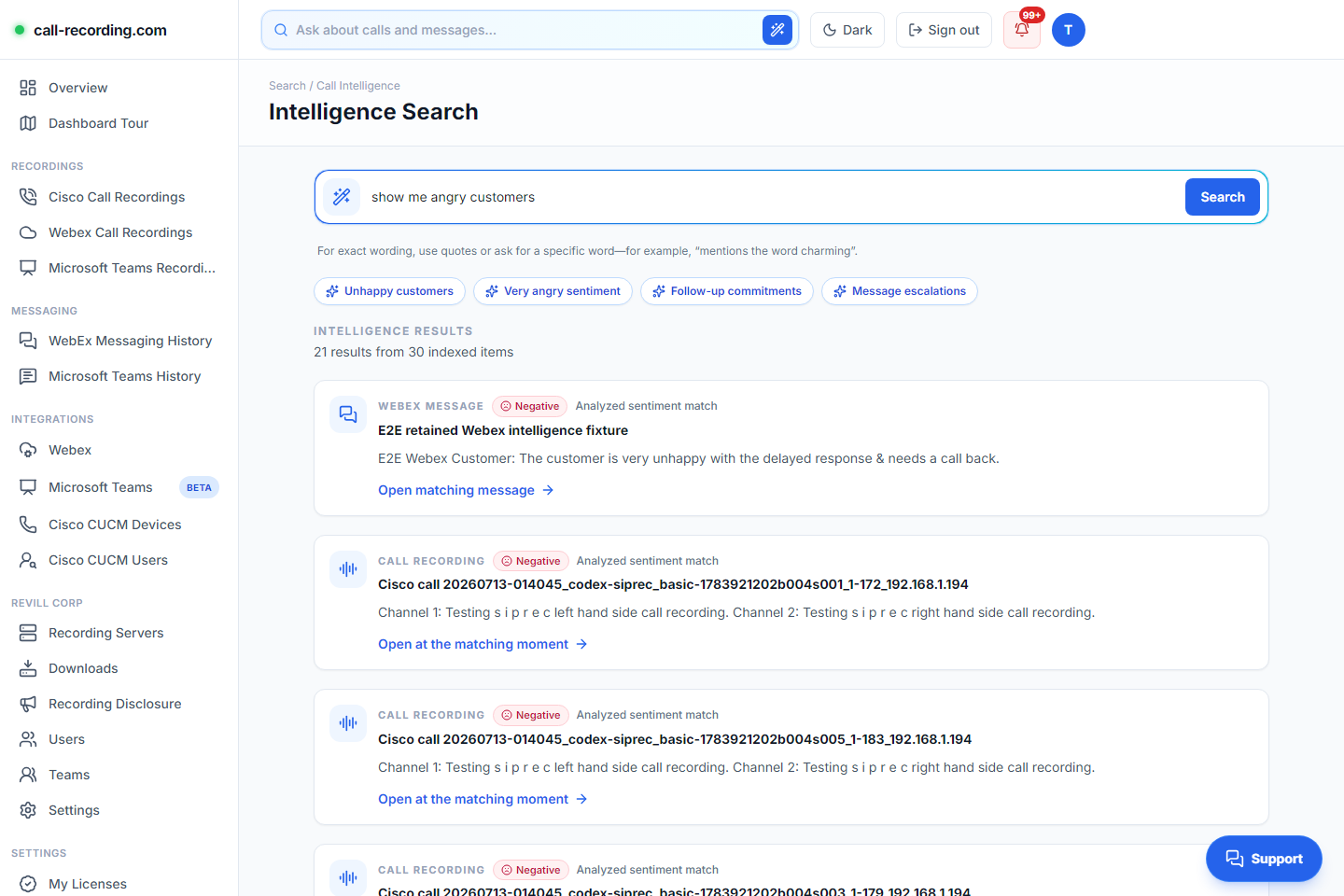
Ask for angry customers, a promised callback, or one exact word, then open the original call or message at that moment with its transcript, waveform, sentiment, and review context.
Signal path
Product fit
Where call-recording.com fits
call-recording.com turns authorized recordings and supported messages into a reviewable evidence trail: search by meaning, sentiment, or exact wording, then open the original source with synchronized playback, transcript, waveform, and timestamped notes.
Most recording archives are easy to fill and surprisingly hard to use. A supervisor often knows the question (“Which customers were angry?”, “Who promised a callback?”, “Did anybody actually say *charming*?”) but not the caller, date, extension, or filename.
call-recording.com Conversation Intelligence closes that gap. It searches authorized Cisco call transcripts and supported Webex or Microsoft Teams content in plain language, while keeping exact wording, semantic meaning, and analyzed sentiment as three separate kinds of evidence.
Three search modes for three different questions
Natural language should not mean “approximately match everything.” The system plans the request and selects the retrieval behavior that fits the question.
| What the reviewer asks | Search behavior | What the result label means |
|---|---|---|
| “Show me angry customers” | Analyzed sentiment | The stored sentiment signal is negative; the transcript does not need to contain the word “angry.” |
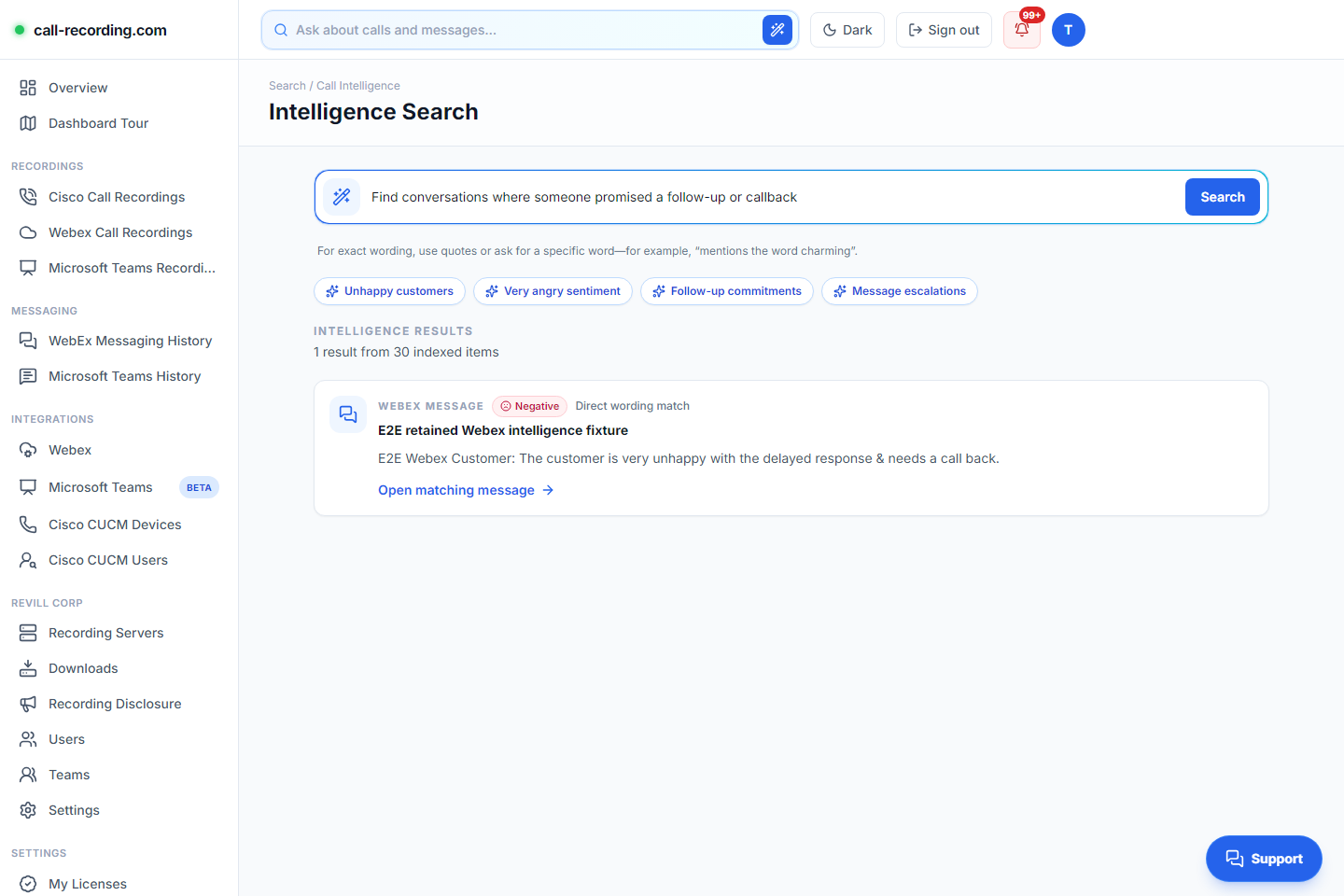
| “Who promised a callback?” | Semantic intent | The wording expresses a callback or follow-up promise, even when the exact grammar differs. |
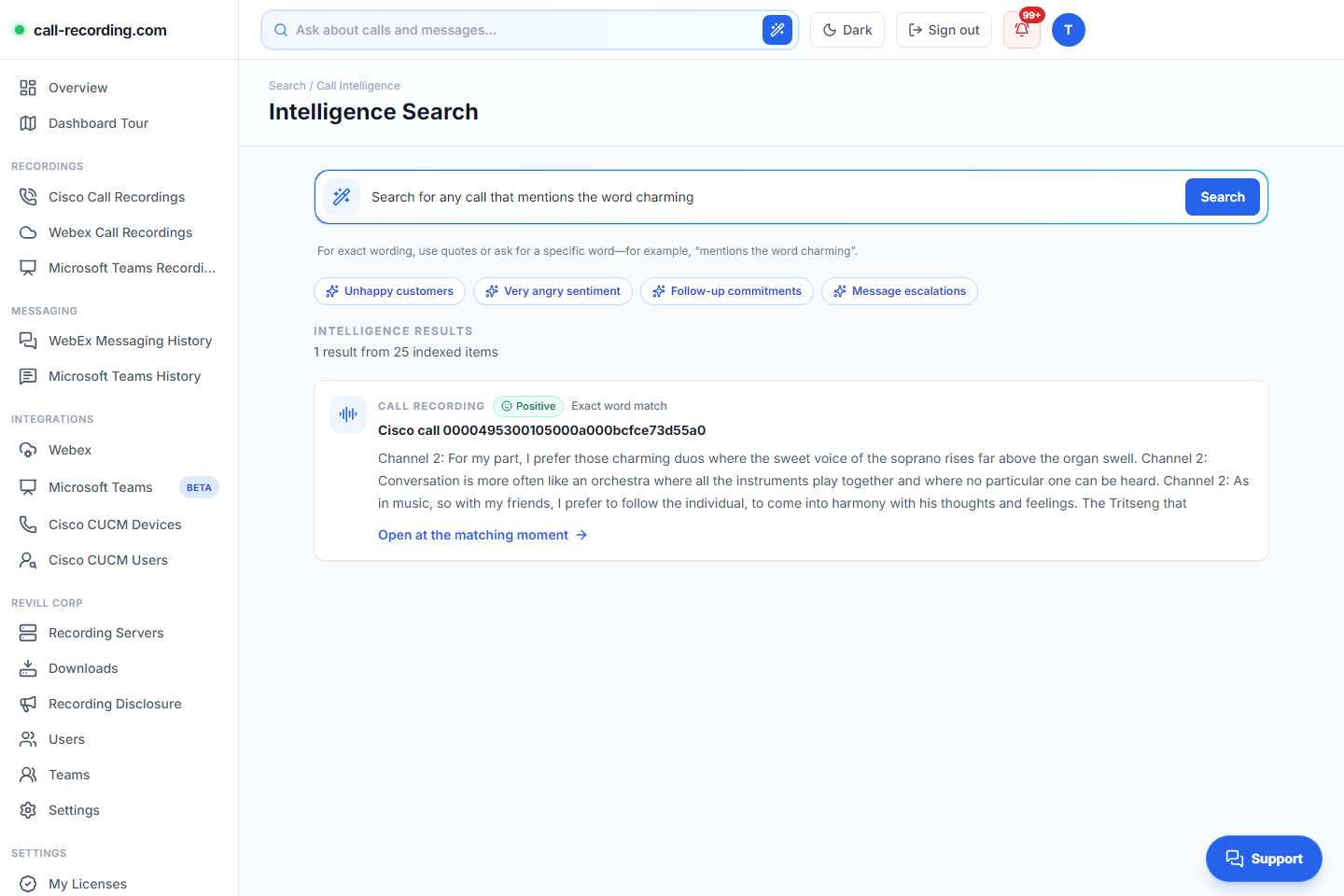
| “Find calls that mention charming” | Exact wording | The literal word occurs in the indexed transcript. |
The distinction matters. A customer can sound frustrated without calling themselves angry, and somebody can discuss “an angry customer policy” in a calm training call. Sentiment metadata and transcript text answer different questions.
Find literal words without semantic guesswork
Some reviews need meaning; others need a word. Names, product codes, required disclosures, prohibited phrases, threats, competitor mentions, and case references are often exact-discovery tasks.
Users can phrase the request naturally, such as “Search for any call that mentions the word charming,” and still get an Exact word match. The result links to the relevant recording moment rather than returning a broad list of thematically related conversations.
Find commitments even when nobody uses your preferred phrase
Operational follow-up is a semantic problem. One agent says “I will call tomorrow.” Another says “Leave it with me and I’ll get back to you.” A customer might ask “Can somebody ring me once it is fixed?”
The reviewer can ask, “Find conversations where someone promised a follow-up or callback.” Results can span supported call transcripts and message history, and a result is flagged as a direct wording match when the source text itself strongly expresses the requested intent.
Useful prompts include:
- Find conversations where a customer asked for a manager.
- Show calls where somebody promised a refund or account credit.
- Find messages that suggest an escalation is needed.
- Find customers with very negative sentiment who also mention delivery.
- Search for the exact phrase “payment authorization”.
- Find calls where a caller repeatedly says the issue is unresolved.
Search across calls and workplace messages
A review rarely stays inside one communications channel. A complaint can begin in a recorded Cisco or Webex call, continue in Microsoft Teams or Slack, and move into a Zoom meeting. The same intelligence search spans every call-recording.com integration while each result preserves its platform, source link, message identity, and sentiment label.
Message history is shown as readable text rather than raw HTML, and the original message view stays available for surrounding context.
Combine a topic with sentiment
“Find angry customers” is a pure sentiment request. “Find angry customers asking for a refund” contains both a sentiment constraint and a topic. In the second case, the system keeps refund intent as the semantic retrieval criterion and applies negative sentiment as an additional filter.
That avoids two unhelpful extremes: returning every negative interaction regardless of subject, or requiring the customer to have spoken the literal word “angry.” Strong wording such as “very angry” or “furious” can narrow the sentiment threshold further.
Review the result, not just the score
A result opens the recording workbench with the caller, callee, extensions, call length, previous and next recording controls, playback speed, skip controls, and timestamped notes.
Two synchronized waveforms keep the recorded channels separate. Clicking either waveform seeks the audio. Clicking a transcript passage does the same, while follow-playback keeps the active text in view. Sentiment changes appear on the same timeline and are labeled as model-generated review aids.
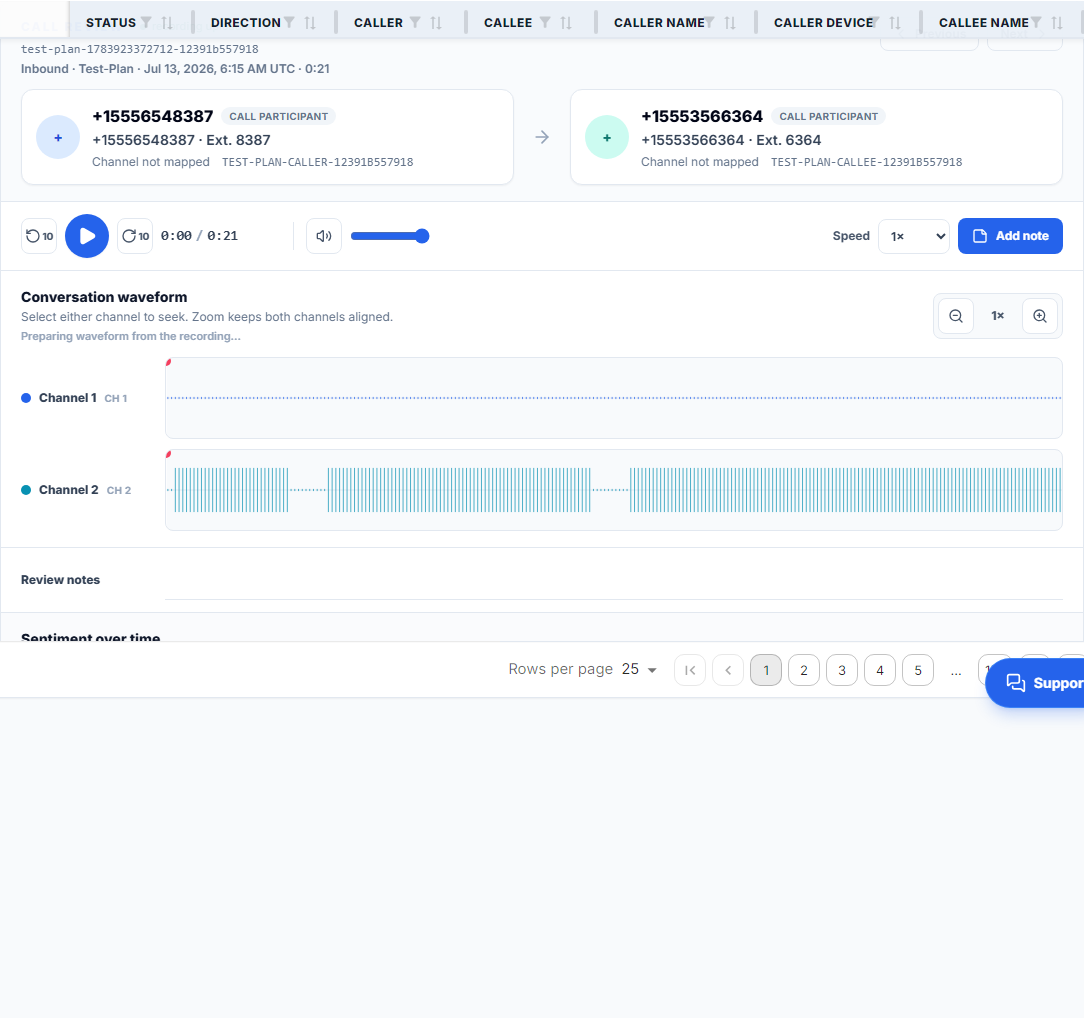
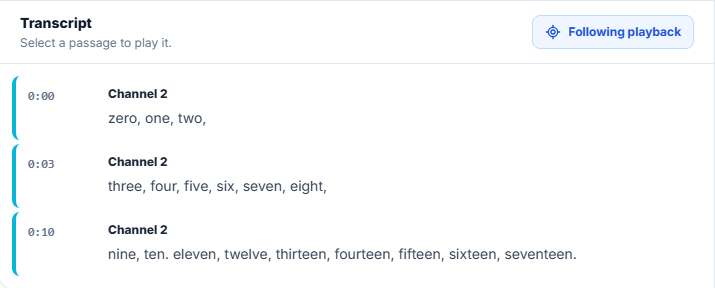
This is also where labels earn their place. A quality lead can mark a coaching moment; an investigator can flag a passage for a second reviewer; a customer-success manager can leave a timestamped reminder to confirm a promised action.
Workplace conduct and anti-bullying review use cases
Communications search can help an authorized team narrow a large evidence set when reviewing alleged bullying, harassment, threats, repeated hostility, or other non-financial misconduct. It should not automatically decide that misconduct occurred.
The legal framework varies. In Great Britain, Acas explains that there is no single specific law against bullying, although related conduct may engage employer duties or laws such as the Equality Act. Section 26 of the Equality Act 2010 defines harassment for purposes of that Act. Australia’s Fair Work Act 2009 contains a statutory workplace-bullying framework. For UK financial services, the FCA’s non-financial misconduct guidance addresses bullying, harassment, and violence, with new rules and guidance applying from 1 September 2026.
A proportionate review could combine several searches:
- Search for literal terms, names, or phrases identified in the complaint.
- Search for meaning such as repeated threats, humiliation, exclusion, or retaliation.
- Treat sentiment and semantic matches as triage signals that locate potentially difficult moments.
- Review the complete passage, speakers, chronology, original audio or message, and any relevant policy context.
- Preserve access boundaries and record the human conclusion separately from the AI signal.
Privacy limits matter just as much. The UK Information Commissioner’s Office guidance on monitoring workers emphasizes lawful purpose, fairness, proportionality, transparency, and data-protection impact assessment. Organizations should obtain jurisdiction-specific legal advice and should not treat a software feature as permission to monitor communications.
From audio to searchable evidence
The processing path is intentionally staged:
- a durable workflow checks entitlement and job limits;
- supported recording audio is transcribed;
- sentiment is analyzed over time;
- transcript and supported message text (not raw audio) are converted into vector embeddings;
- authorized searches combine exact text, semantic retrieval, sentiment metadata, and source filters;
- results link back to the current retained source.
This design keeps the original evidence and each derived signal distinct. Transcription, sentiment, embeddings, and search results can assist review, but none replace the recording, policy, or human judgment.
Keep access and retention in the query boundary
Search must never become a shortcut around recording permissions. Results stay organization-scoped, and identity-restricted reviewers see only calls they are already permitted to access. Current retained source versions are searched; a tombstoned source can remain preserved according to policy without being presented as an active search result.
That boundary is particularly important for workplace investigations, regulated communications, and legal review. The search tool should reduce the volume a reviewer must inspect, not silently widen who can see the underlying communications.
Try questions from your real review queue
The best evaluation is not a polished demo query. Use calls and messages your team is lawfully authorized to review, then test questions that normally consume time: unresolved complaints, missed callbacks, required phrases, unusual product terms, hostile interactions, or recurring service failures.
Start with the Conversation Intelligence product page, review the broader compliance recording and retention guide, and validate the workflow during the free trial.
Bottom line
Conversation intelligence is most valuable when it is precise about what kind of match it found and humble about what that match proves. Ask in ordinary language, distinguish sentiment from meaning and literal wording, then base the decision on the original call or message, not an AI score.
Product fit
Where call-recording.com fits
call-recording.com turns authorized recordings and supported messages into a reviewable evidence trail: search by meaning, sentiment, or exact wording, then open the original source with synchronized playback, transcript, waveform, and timestamped notes.
Sources
Primary references and technical evidence
Check commands, legal scope, and policy decisions against the current version of each source for your environment.
Legal and compliance content is general information, not legal advice. Cisco behavior and commands vary by release, platform, firmware, and call flow.
Keep reading