Cisco buying guide
Cisco CUCM Call Recording Cost: Licenses, Storage, and Services
Build a comparable five-year estimate from real users, call paths, recorded minutes, retention, security work, implementation, and support.
Signal path
Product fit
Where call-recording.com fits
Call Observe publishes platform pricing and supports guided self-service, customer-hosted capture, health alerts, search, playback, retention, and audit controls; the customer still prices its Cisco entitlements and infrastructure.
Short answer
Cisco CUCM call-recording cost is not one license price. The total combines Cisco entitlements, the recording platform, recorder infrastructure, storage and retention, network and security work, implementation effort, and ongoing operations.
To get a useful estimate quickly, count recorded users and concurrent calls, define the recording architecture, measure monthly recorded minutes, set retention, list required integrations and compliance controls, and price the same scope across every option.
Call Observe publishes its platform price on the call-recording.com pricing page and is designed for self-service deployment. Cisco licensing and customer infrastructure still need to be confirmed for the customer's agreements and release.
What cost categories should be included?
| Cost category | Main driver | Questions to ask |
|---|---|---|
| Cisco licensing | Existing CUCM or Webex entitlements and support agreement | Is the calling feature already entitled? Does the target release or migration change it? |
| Recording platform | Recorded users, channels, concurrent calls, features, or usage | What is included for capture, storage, search, retention, audit, and support? |
| Recorder infrastructure | CPU, memory, local disk, hypervisor, operating system, backup | Is the recorder customer-hosted, vendor-hosted, physical, virtual, or cloud? |
| Media storage | Minutes, codec, retention, replicas, legal holds, exports | How much new audio arrives each month and how long is each class kept? |
| Network and security | Sites, firewalls, certificates, TLS or SRTP, monitoring | Which endpoints or gateways must reach which recorder addresses and ports? |
| Implementation | Discovery, design, configuration, testing, training, migration | Can the team use guided self-service, or does complexity require specialist services? |
| Operations | Monitoring, incidents, access review, compliance sampling, upgrades | Who owns missing recordings, codec faults, capacity, certificates, and audits? |
Use the same categories for a cloud service, appliance, professional-services project, or existing vendor renewal. A low license quote can hide expensive implementation or storage.
Which Cisco license costs apply?
Cisco entitlements depend on the deployment and commercial agreement. The current CUCM licensing guide explains licensing for the release, while the Cisco Collaboration Flex Plan data sheet describes current subscription packaging.
Do not assume that a recording feature, contact-center feature, phone conversion, Webex integration, or support entitlement is included because another customer had it. Ask the Cisco partner or account team to map the actual contract, users, devices, calling platform, and migration plan.
How does the recording architecture change cost?
Built-In Bridge
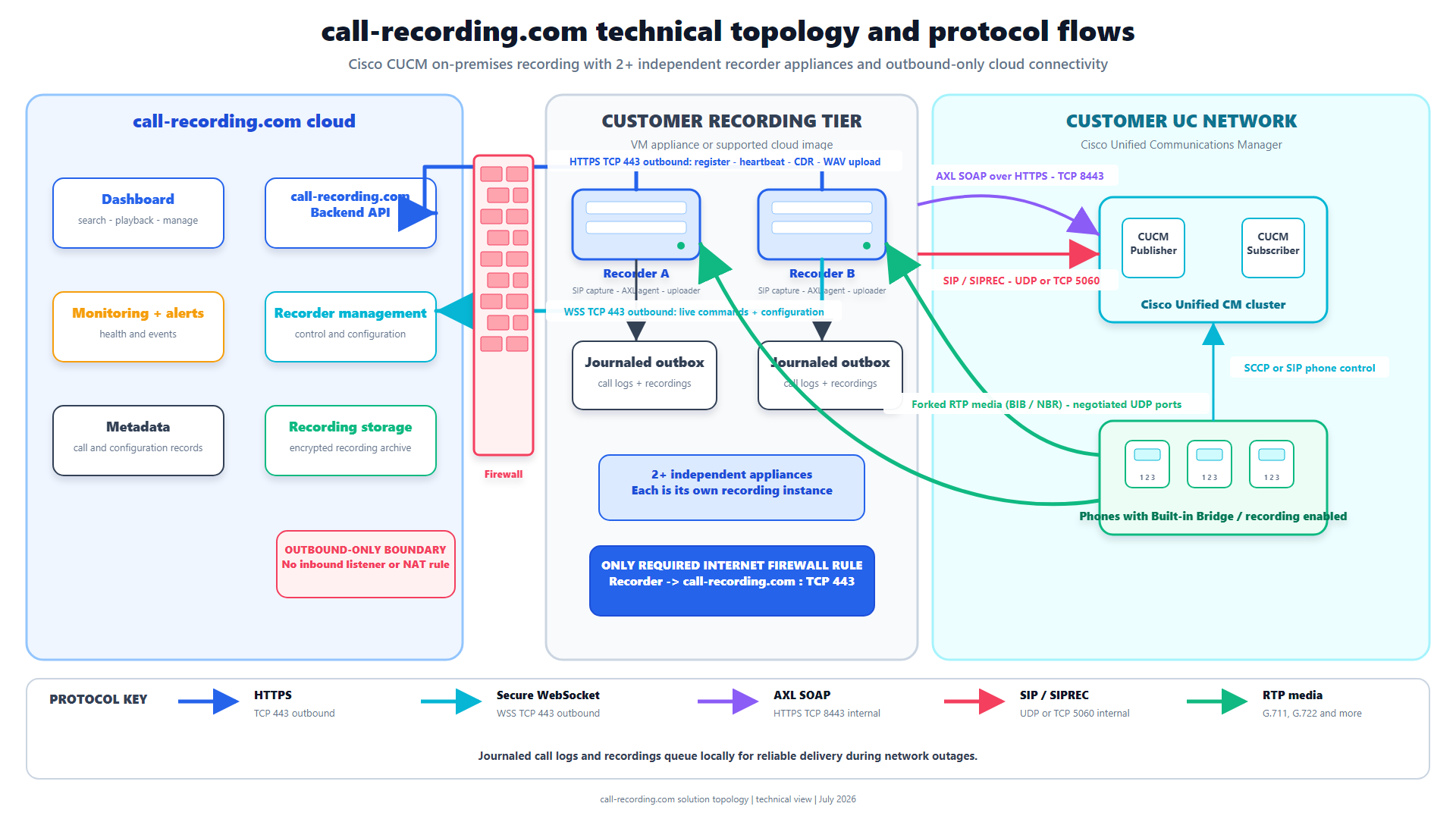
Phone-based recording can avoid a separate media fork at the border, but it depends on supported endpoints, correct CUCM line settings, and RTP reachability from every phone or soft client. A mixed device estate can increase discovery and test effort.
CUCM network-based recording
Gateway-sourced recording can help with mobile or remote calls, but eligible gateway models, software, call paths, source-selection rules, and capacity must be checked. Gateway Preferred can still fall back to a phone.
CUBE SIPREC
CUBE SIPREC can centralize capture for calls that cross selected CUBE dial peers. Include CUBE platform and software entitlements, session capacity, redundancy, configuration, and the cost of covering internal or alternate-path calls that bypass the CUBE.
The recording-method comparison helps you avoid an architecture that is cheap but incomplete.
No time to waste translating raw call detail records? Use Call Recordings FREE tool below!
CDR Clarity
Free from call-recording.com
The smarter way to view Call Records
Our free tool decodes Cisco CUCM call records into plain language and displays them in a beautiful "spreadsheet" inspired UI.
Open free CDR viewerHow should storage be estimated?
Start with usage rather than users:
monthly recorded minutes = recorded users × average recorded calls per user per day × average call minutes × working days
Then apply the measured encoded audio size per minute for the platform and include metadata, indexes, transcripts, replicas, local delivery buffer, growth, and legal holds.
For a first estimate:
- export one representative month of call detail records;
- filter to calls actually in recording scope;
- group by codec, call type, business unit, and retention class;
- measure sample file sizes from the proposed recorder;
- add normal growth and a documented safety margin; and
- separate recurring cloud retention from temporary local persistence.
Do not estimate storage from raw RTP bit rate alone. Container overhead, channel layout, compression, transcripts, indexing, and the platform's storage format affect the result.
When do services become necessary?
Guided self-service can reduce professional-services cost for a prepared administrator and a straightforward pilot. Specialist help may still be justified for:
- multiple clusters or overlapping dial plans;
- secure SIP and SRTP with complex certificate policy;
- mixed Built-In Bridge, gateway, and SIPREC sources;
- UCCX or larger contact-center workflows;
- unsupported or varied endpoint estates;
- formal high availability and disaster recovery;
- large automatic-recording rollouts; or
- regulated acceptance, migration, and evidence requirements.
Use the self-service CUCM setup guide to identify the work the internal team can complete. Use the proof-of-concept checklist before buying for full scale.
What hidden costs should be tested?
Include the work created by failure:
- calls missing because a line, route, endpoint, or gateway was out of scope;
- one-way or silent recordings caused by an RTP path;
- codec negotiation failures;
- manual reconciliation and support tickets;
- exports or legal requests that take too long to retrieve;
- storage that grows because retention was never enforced;
- certificate, upgrade, and security-review effort; and
- duplicate tools during a CUCM-to-Webex migration.
Call Observe exposes no-RTP and codec-failure counts on the dashboard and sends recorder-health notifications. That can shorten the time between a fault and an investigation, but the operating team still needs an owner and a response process.
A fair five-year comparison
For each option, calculate:
five-year TCO = setup + infrastructure + licenses and subscriptions + storage growth + support and operations + migration or exit costs
Keep these assumptions identical:
- recorded users and peak concurrent calls;
- included call paths and platforms;
- monthly minutes and growth;
- retention classes and legal holds;
- resilience and recovery target;
- security, audit, search, export, and compliance features;
- implementation and training scope; and
- support hours and response expectations.
Ask vendors to mark exclusions and variable charges. Do not compare a license-only number with an implemented, stored, supported service.
Bottom line
The right CUCM call-recording budget begins with scope and call flow. Confirm Cisco entitlements, choose a recording source that covers every required call, estimate real media volume and retention, and include implementation and operations.
Call Observe makes the platform subscription visible and supports guided self-service, customer-hosted capture, health alerts, search, playback, retention, and audit workflows. The final cost still depends on the customer's Cisco estate, capacity, security, storage, and operating model.
Still struggling to decipher your call detail records? Try our user friendly tool!
CDR Clarity
Free from call-recording.com
The smarter way to view Call Records
Our free tool decodes Cisco CUCM call records into plain language and displays them in a beautiful "spreadsheet" inspired UI.
Open free CDR viewerProduct fit
Where call-recording.com fits
Call Observe publishes platform pricing and supports guided self-service, customer-hosted capture, health alerts, search, playback, retention, and audit controls; the customer still prices its Cisco entitlements and infrastructure.
Sources
Primary references and technical evidence
Check commands, legal scope, and policy decisions against the current version of each source for your environment.
Legal and compliance content is general information, not legal advice. Cisco behavior and commands vary by release, platform, firmware, and call flow.
Keep reading