Financial compliance field guide
A Guide to the Dodd-Frank Act and Call Recording Requirements
What the U.S. swap-recordkeeping rules actually require, who is in scope, which communications matter, and how to turn Cisco call capture into a defensible evidence workflow.
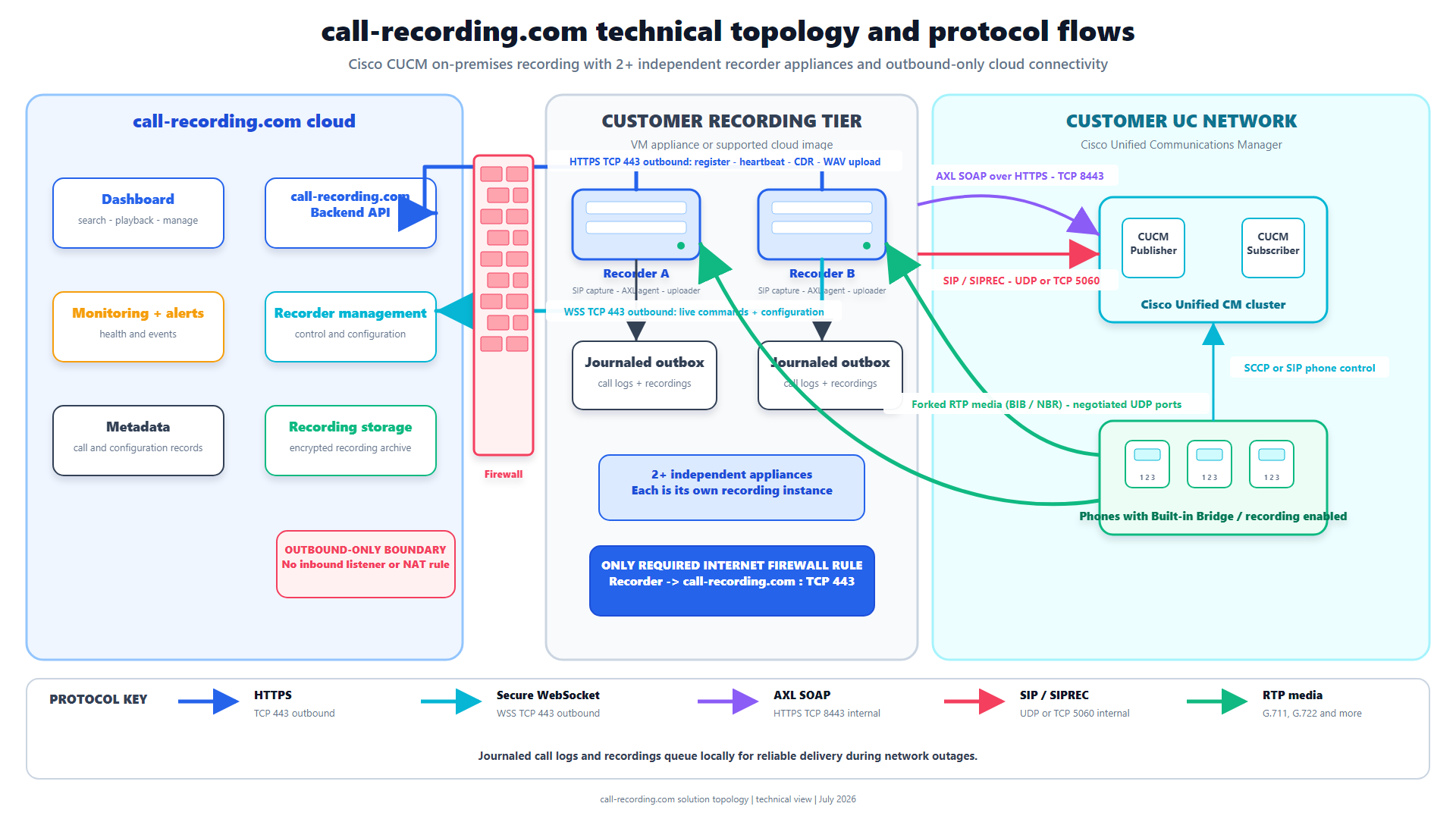
Signal path
Where call-recording.com intervenes
From technical requirement to working recording
call-recording.com connects Cisco voice capture with searchable recordings, configurable retention, delivery status, and organization-scoped access—the operational controls needed to turn a recording policy into evidence.
The short answer: Dodd-Frank is not a record-every-business-call law
“Dodd-Frank call recording” is often used as shorthand for recordkeeping obligations created under Title VII of the Dodd-Frank Wall Street Reform and Consumer Protection Act. The important detail is scope. The rules do not automatically require every financial company to record every telephone call.
For the CFTC-regulated swaps market, 17 CFR § 23.202 requires swap dealers and major swap participants to create searchable records of specified pre-execution communications and related transaction information. The SEC administers a parallel framework for security-based swaps. Whether a firm, desk, person, product, or communication is covered is a legal and regulatory classification question.
This guide is operational information, not legal advice. Have qualified counsel and compliance leadership define the regulated population before configuring Cisco recording.
What communications are covered by the CFTC rule?
The current text of 17 CFR § 23.202 requires records of oral and written communications provided or received concerning quotes, solicitations, bids, offers, instructions, trading, and prices that lead to the execution of a swap or related cash or forward transaction.
The rule expressly reaches communications through:
- telephone;
- voicemail;
- mobile device;
- instant messaging;
- chat rooms;
- electronic mail;
- other digital or electronic media.
The phrase “that lead to the execution” matters. This is not simply a quality-assurance recording rule for a contact center. It is a transaction-reconstruction obligation tied to regulated dealing activity. A scoping exercise should connect regulated products, covered personnel, approved channels, Cisco identities, mobile usage, and retention policy.
call-recording.com can capture and manage the Cisco voice component of that program. It does not make an out-of-scope communication regulated or make an unapproved mobile channel compliant.
What must the record support?
A recording is useful only when the firm can retrieve it and relate it to the transaction and people involved. The CFTC framework emphasizes searchable records, timing information, and reconstruction.
Operationally, a Dodd-Frank recording design should preserve:
- complete audio for the covered conversation;
- caller, called party, user, device, and extension context;
- start and end timestamps with a documented time standard;
- a stable recording identifier;
- the relationship between communication and transaction records;
- retention state and disposition;
- evidence of successful capture and delivery;
- access history and administrative accountability.
The CUCM Call Detail Records guide explains the metadata available from Cisco CDR and CMR. CDR is not a substitute for audio, but it can help reconcile recording populations and investigate gaps.
Retention and prompt retrieval
Retention rules must be read together. Section 23.203 points covered entities to the applicable recordkeeping provisions, including 17 CFR § 1.31. The exact retention period depends on the record category and current rule text; oral communications have historically received a different period from many transaction records.
Do not turn a marketing summary into a retention schedule. Compliance should document:
- the record class;
- the controlling CFTC, SEC, FINRA, exchange, state, or other requirement;
- the start event for the retention period;
- legal-hold behavior;
- the required retrieval time;
- permitted storage media and format;
- destruction approval and evidence.
call-recording.com provides configurable recording retention and searchable access. Those controls let the business implement an approved schedule without treating “keep everything forever” as a compliance strategy.
Why completeness is the real control objective
The highest-risk failure is often not that a recording sounds slightly imperfect; it is that an in-scope communication is missing and nobody knew. The CFTC’s enforcement action against Goldman Sachs described failures to record and retain required audio, including mobile-device calls and problems associated with recording software.
A defensible program therefore asks:
- Which covered people are expected to use which Cisco devices?
- Are alternate and shared lines included?
- What happens during extension mobility, remote work, transfer, and conference?
- Are mobile and collaboration channels governed separately?
- How is a failed recording surfaced?
- Can expected call records be reconciled to delivered recordings?
- Does a connectivity outage create a silent gap?
The call-recording.com recording integrity design addresses the last two questions with local persistence, a journaled outbox, durable retry behavior, and confirmation-driven delivery.
No time to waste translating raw call detail records? Use Call Recordings FREE tool below!
CDR Clarity
Free from call-recording.com
The smarter way to view Call Records
Our free tool decodes Cisco CUCM call records into plain language and displays them in a beautiful "spreadsheet" inspired UI.
Open free CDR viewerCisco architecture for a regulated recording population
For Cisco businesses, the recording point normally follows the call path.
| Cisco environment | Likely capture approach | Design question |
|---|---|---|
| CUCM desk phones | Built-In Bridge and CUCM recording profiles | Do all covered phones, firmware, and line appearances support and enable BIB? |
| Calls traversing CUBE | SIPREC media forking | Do covered calls consistently traverse the selected CUBE dial peers? |
| UCCX and Finesse agents | CUCM/contact-center recording policy | Are agent identity, device state, transfers, and supervisor features preserved? |
| Webex workloads | Platform-specific recording integration | Is the recording source and retention authority cloud-native or customer-managed? |
| Mobile communications | Separate approved mobile capture/control | Does the Cisco voice design actually include the mobile leg? |
Use the Cisco Built-In Bridge guide and the Cisco CUBE SIPREC guide to select the right capture point.
Supervision, policy, and approved channels
Technology should enforce a policy that is already explicit. A regulated communications policy normally identifies covered roles, allowed devices, approved channels, prohibited channels, escalation, training, attestations, surveillance, and consequences.
Cisco recording can cover the configured voice path very well. It cannot stop an employee from using an unapproved personal application unless the wider compliance program controls that behavior. That is why Dodd-Frank recording projects need coordination among compliance, legal, voice engineering, security, HR, and business leadership.
call-recording.com makes the approved Cisco path easier to deploy and operate. Its role is concrete: capture the intended Cisco calls, protect and deliver the recording, make it searchable, apply retention, and expose the state of the recording workflow.
Security and access control
Regulated recordings can contain market-sensitive information, personal data, authentication details, and confidential client instructions. Broad access creates a second compliance problem.
Apply least privilege to:
- recording search and playback;
- download and export;
- deletion and retention changes;
- user and organization administration;
- recorder configuration;
- incident investigation;
- legal-hold workflows.
The call-recording.com security architecture uses a low-footprint customer recorder with outbound HTTPS communication, authenticated cloud access, organization scoping, and encrypted recording storage. Recordings are also encrypted at rest on the local recorder host before delivery.
Outage resilience and delivery evidence
A cloud or WAN interruption should not turn into an unreported recording gap. call-recording.com separates capture from upload: the customer-hosted recorder can persist work locally, record it in the delivery journal, retry after connectivity returns, and wait for cloud confirmation before completing the delivery lifecycle.
That pattern matters in regulated environments because “the internet was down” does not reconstruct a missing communication. The control objective is continuity plus evidence:
- capture continues at the Cisco recording point;
- audio is encrypted at rest on the local recorder host;
- the call and recording enter a durable journal;
- delivery retries resume when connectivity is available;
- cloud receipt confirms the upload;
- monitoring and reconciliation expose anything still pending.
Read Recording Integrity for the detailed failure-path explanation.
Dodd-Frank recording implementation checklist
Use this checklist as the engineering handoff after counsel defines scope:
- Identify the exact registered entities and regulated activities.
- Map covered employees, supervisors, desks, extensions, devices, and alternate channels.
- Define which pre-execution communications must be retained.
- Select BIB, SIPREC, Webex, mobile, or another capture method for each channel.
- Set an authoritative time source across CUCM, CUBE, recorders, and transaction systems.
- Configure notice and employee monitoring disclosures as required.
- Define retention, legal hold, retrieval, export, and destruction.
- Restrict playback, download, administration, and deletion.
- Reconcile expected Cisco calls to delivered recordings.
- Test hold, transfer, conference, remote work, outage, restart, and recovery.
- Train covered personnel on approved communication channels.
- Schedule periodic control testing and evidence review.
Where call-recording.com fits
call-recording.com is purpose-built for businesses recording Cisco communications. It combines guided Cisco provisioning, customer-hosted capture, encrypted local and cloud storage, durable delivery, recording search, scoped access, and configurable retention.
For a Dodd-Frank program, that means the Cisco voice team can deliver a measurable recording control instead of a collection of phone settings. Compliance still owns scope and policy; call-recording.com makes the approved technical path faster to deploy, easier to observe, and easier to retrieve.
Still struggling to decipher your call detail records? Try our user friendly tool!
CDR Clarity
Free from call-recording.com
The smarter way to view Call Records
Our free tool decodes Cisco CUCM call records into plain language and displays them in a beautiful "spreadsheet" inspired UI.
Open free CDR viewerWhere call-recording.com intervenes
From technical requirement to working recording
call-recording.com connects Cisco voice capture with searchable recordings, configurable retention, delivery status, and organization-scoped access—the operational controls needed to turn a recording policy into evidence.
Source ledger
Primary references and technical evidence
Validate version-specific commands, legal scope, and policy decisions against the current source applicable to your environment.
Legal and compliance content is general information, not legal advice. Cisco behavior and commands vary by product release, platform, firmware, and call flow.
Continue the research