Workplace conduct
AI Analytics for Workplace Bullying and Respect-at-Work Investigations
How communications evidence can support a respect-at-work program, what the UK Bullying and Respect at Work Bill proposed, and why source-linked human review beats an opaque label.
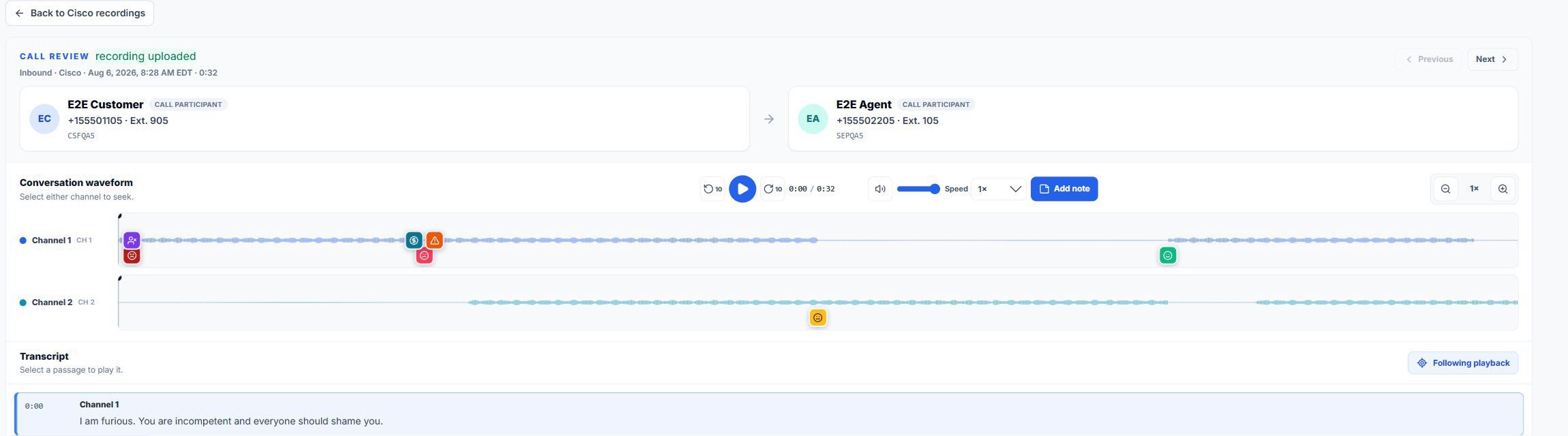
Dashboard screenshot
Live dashboard view using synthetic data: suspected bullying, regulated-finance, PII, and emotion markers align to the original dual-channel recording.
Signal path
Product fit
Where call-recording.com fits
call-recording.com flags suspected bullying across authorized calls and messages on every integration, then keeps the platform, channel, timestamp, confidence, rationale, censored evidence, and original conversation together for auditable human review.
Workplace investigations often begin with a name, a date range, and a concern that is difficult to express as a database query. Relevant evidence may span calls, meeting transcripts, direct messages, channels, and contact-center conversations. call-recording.com AI Analytics helps an authorized team review them as one source-linked timeline.
The aim is evidence readiness: identify potentially relevant passages, preserve their context, and help a human investigator test an allegation fairly. An AI score should never become an employment finding.
The Bullying and Respect at Work Bill did not become law
The UK Bullying and Respect at Work Bill was a Private Member's Bill proposed during the 2024–26 parliamentary session. Its long title contemplated a statutory definition of bullying, employment-tribunal claims, a Respect at Work Code, and EHRC powers. The Parliamentary stages record shows only a Commons first reading on 21 October 2024.
When that session ended, Parliament confirmed that the Bill would make no further progress. It is not an upcoming UK anti-bullying law. Existing employment, equality, grievance, privacy, and sector-specific obligations can still make workplace conduct records important.
Start from the law and guidance that actually apply
Acas says there is no single specific law against bullying. It describes bullying as offensive, intimidating, malicious, or insulting behaviour, or an abuse or misuse of power that undermines, humiliates, or harms someone. Acas also notes that conduct may amount to discrimination when connected to a protected characteristic, and that employers should take complaints seriously and investigate promptly.
The EHRC technical guidance addresses harassment, victimisation, employer liability, and the positive duty to take reasonable steps to prevent sexual harassment. Those concepts are more precise than treating every difficult workplace exchange as legally equivalent.
Account for the Employment Rights Act 2025 changes
The Acas Employment Rights Act 2025 timetable records that the Act became law on 18 December 2025, with changes staged through 2026 and 2027. From 6 April 2026, sexual-harassment disclosures became qualifying disclosures for whistleblowing protection.
Acas says October 2026 changes include employer liability for third-party harassment unless all reasonable steps were taken, and an “all reasonable steps” standard for preventing sexual harassment. Implementation details may depend on consultation. Evidence readiness can support a documented response, but software does not determine which provision applies.
Define the investigation question before searching
An investigation should define the alleged conduct, people, period, business channels, relevant policies, potential witnesses, and authorized reviewers. That prevents an open-ended search from becoming routine surveillance.
Useful questions are specific: Was a threat repeated? Did humiliating language continue after an objection? Did conduct move from a public channel to messages or calls? Search should also include material that may contradict the allegation.
Unify evidence across communication platforms
call-recording.com brings calls and messages into a consistent review layer across Cisco CUCM and Webex, plus 8x8, Aircall, Amazon Connect, Dialpad, Discord, Five9, Genesys Cloud, GoTo Connect, Google Workspace, Intercom, JustCall, Mattermost, Microsoft Teams, NICE CXone, OpenPhone, RingCentral, Rocket.Chat, Slack, Talkdesk, Twilio, Vonage, Zendesk, and Zoom.
This cross-platform scope matters when the chronology crosses a Cisco call, a Teams meeting, a Slack thread, and a later Zoom conversation. Platform, sender, participants, conversation identity, and timestamps remain attached so investigators can navigate a unified conversation view without pretending the sources are interchangeable.
Use bullying detection as a triage signal
The AI classifier looks for suspected targeted humiliation, harassment, intimidation, threats, coercion, or degrading conduct. It can analyze message text and timestamped call transcripts, then present a badge on the message or a marker at the relevant place on the waveform.
Ordinary disagreement, criticism, complaint handling, or firm workplace direction is not automatically categorized as bullying. The investigator sees a candidate passage and its context rather than a system-generated verdict, which surfaces risks sooner without compromising a fair review.
Inspect source-linked explanations
Each finding includes the source segment, call channel where available, start and end time, confidence, concise rationale, and a bounded evidence excerpt. Clicking a waveform marker seeks the audio to that moment. Clicking a transcript passage does the same. Message findings remain linked to the original conversation view.
When someone asks why an item entered the queue, the answer points to a real source and time range instead of a bare risk score. Model and version provenance, job state, timestamps, and current-result promotion add an audit trail.
Treat emotion changes as context, not a conclusion
Dual-channel call analysis marks changes among happy, neutral, unhappy, and angry for each channel. These markers can help an investigator locate escalation, de-escalation, or a sharp change in tone. They are most useful beside the transcript and audio.
Emotion does not establish bullying, intent, truthfulness, or impact. A calm threat can be serious; an angry response can follow provocation. The workbench keeps emotion separate from suspected-conduct findings so the reviewer can weigh both against the original exchange.
Search exact words, meaning, and detection records
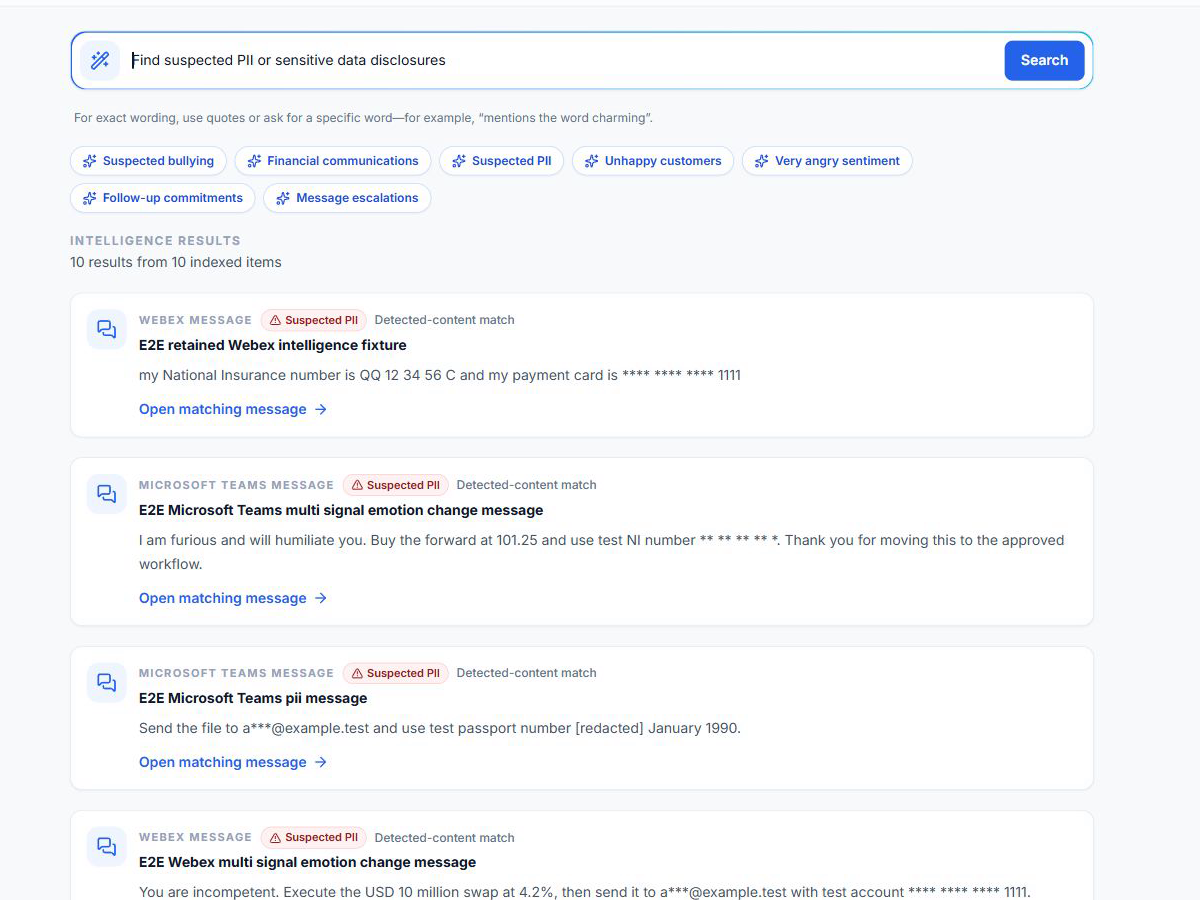
Investigators can combine several retrieval modes. Exact search finds a name, phrase, slur, policy term, or case reference. Lexical search expands ordinary wording. Semantic search finds similar meaning when speakers use different language. Detection-aware search retrieves stored bullying findings directly rather than relying on a fresh semantic guess.
The Conversation Intelligence search workflow can also return authorized calls and messages together. Search results retain platform and source links, enabling an investigator to reconstruct chronology rather than review isolated snippets.
Protect PII inside sensitive investigations
Workplace evidence can contain contact details, government identifiers, payment-card data, health information, union communications, and third-party information. PII detection combines ML with deterministic validation and masks supported identifiers in evidence and notifications.
Masking reduces unnecessary repetition, but access control, retention, and purpose limitation still matter. The broader communications governance and chain-of-custody guide explains how capture, preservation, production, and deletion should fit a documented policy.
Apply the ICO monitoring safeguards
The ICO's worker-message monitoring guidance says employers must define a clear purpose, ensure monitoring is necessary and proportionate, inform workers, and complete a data protection impact assessment for email and message monitoring. It also asks organizations to distinguish metadata from content and identify communications that should not be monitored.
Those safeguards should shape configuration before an investigation begins: collect only in-scope business channels, restrict reviewers, set retention rules, document exceptions, and avoid expanding one allegation into unrestricted employee monitoring.
Keep human oversight meaningful
The ICO's automated-process guidance for worker monitoring emphasizes meaningful human involvement. A reviewer should be engaged, critical, able to challenge the recommendation, and authorized to reach a different conclusion.
The investigator should review surrounding messages, listen around each marker, verify participants and time zones, consider witness evidence, record contrary material, and document an independent conclusion. The AI queue is a starting point, not the disciplinary record.
Use notifications without prejudging the case
Per-user notifications can report when analysis starts, succeeds, fails, or detects suspected bullying. They include platform, source type, friendly event time, available participant context, finding count, a censored excerpt, and a deep link to the authorized source.
This supports proactive compliance and timely case handling. Notification wording remains “possible” or “suspected,” so an operational alert does not silently become a finding of fact. Dashboard and email preferences can be configured separately for the people assigned to review.
Build a defensible investigation record
A defensible file should preserve scope, search terms, platforms checked, relevant sources, AI provenance, cited passages, reviewer notes, contrary evidence, interviews, decisions, and follow-up. call-recording.com provides source-linked findings, timestamped notes, current analysis versions, and deep links.
The product does not replace HR, employee relations, privacy, employment counsel, or a fair grievance process. It gives those functions broader search coverage, faster response, and more context, so they can work from a more complete communications timeline.
Prepare for respect-at-work investigations now
The 2024–26 Bill is no longer progressing, but respectful-workplace investigations remain a live operational need. Organizations can prepare by defining lawful capture scope, connecting business platforms, validating retention and access, documenting AI oversight, and testing how investigators move from an alert to the original evidence.
The evidence path joins Conversation Intelligence, accountable recording integrity, the security architecture, and flexible recorder deployment so the source, analysis, and review context remain connected.
Explore AI Analytics, Conversation Intelligence, and workplace messaging capture to build one explainable review workflow across calls and collaboration history.
Product fit
Where call-recording.com fits
call-recording.com flags suspected bullying across authorized calls and messages on every integration, then keeps the platform, channel, timestamp, confidence, rationale, censored evidence, and original conversation together for auditable human review.
Sources
Primary references and technical evidence
Check commands, legal scope, and policy decisions against the current version of each source for your environment.
Legal and compliance content is general information, not legal advice. Cisco behavior and commands vary by release, platform, firmware, and call flow.
Keep reading