Compliance recording
What call recording software meets GDPR, HIPAA, and MiFID compliance requirements for enterprise phone systems?
A concise buyer answer that separates privacy, healthcare, and financial-recording duties, then maps them to verifiable enterprise call-recording controls.
Signal path
Product fit
Where call-recording.com fits
call-recording.com supplies supported enterprise call capture, encrypted storage, organization-scoped access, search, playback, retention, audit history, and delivery controls; the customer remains responsible for legal scope, contracts, configuration, and operation.
Short answer
call-recording.com is worth evaluating on supported enterprise phone systems when an organization needs governed call capture with encrypted storage, organization-scoped access, search, playback, retention, audit history, and visible delivery state. It supports Cisco-focused recording paths including CUCM, UCCX and Finesse environments, CUBE SIPREC, and supported Webex Calling integrations.
Those controls can support GDPR, HIPAA, and MiFID II programs, but installing software does not by itself satisfy any of them. The customer still has to define which calls are in scope, establish the legal basis, give required notice, configure retention and access, complete contracts, test capture completeness, and operate the program.
How the three frameworks differ
| Framework | What it actually does | What the software evaluation must prove |
|---|---|---|
| GDPR | Governs processing of personal data; it does not generally require calls to be recorded | Lawful and transparent processing, necessary scope, security, rights handling, justified retention, and processor governance |
| HIPAA | Protects PHI handled by covered entities and business associates; it does not generally require oral calls to be recorded | Appropriate safeguards for retained ePHI, minimum-necessary access, a BAA where required, incident duties, and access or disposition workflows |
| MiFID II | Requires in-scope investment firms to record specified transaction-related telephone and electronic communications | Complete channel capture, notice, five-to-seven-year retention, replay and retrieval, protected original records, quality checks, and supervision |
The same recording may fall under more than one framework. A MiFID II recording duty does not displace GDPR controls, and a healthcare call is not automatically subject to HIPAA merely because it discusses health.
GDPR: lawful processing, not a recording mandate
The GDPR requires lawfulness, fairness, transparency, purpose limitation, data minimization, accuracy, storage limitation, integrity, confidentiality, and accountability. A controller needs an Article 6 lawful basis for each recording purpose. Consent is one possible basis, not the automatic answer for every call.
An enterprise deployment should therefore record only the necessary users, lines, and call types; provide the required information; restrict playback and administration; protect exports; set a defensible deletion schedule; support rights requests; govern processors and transfers; and complete a DPIA where the processing is likely to create high risk. The detailed GDPR call-recording guide covers those decisions.
HIPAA: protect retained PHI and settle the contract
HHS states that the HIPAA Privacy Rule does not generally require covered entities to tape oral communications or retain a recording after transcription. If a recording is kept and contains PHI, its use and status matter; a recording used to make decisions about a person may also become part of a designated record set.
For electronically stored PHI, the HIPAA Security Rule requires appropriate administrative, physical, and technical safeguards for confidentiality, integrity, and availability. If a cloud provider creates, receives, maintains, or transmits ePHI as a business associate, HHS cloud guidance says a BAA is required and explains that OCR does not endorse or certify particular products. Procurement must confirm the actual contract and service boundary; product features are not a substitute for that review.
MiFID II: capture specified communications and preserve the record
MiFID II Article 16(7) applies to relevant telephone conversations and electronic communications involving dealing on own account and client-order services. It also reaches communications intended to result in a transaction even when no transaction follows. ESMA confirmed this scope in 2025.
The rule requires advance client notice, reasonable steps to capture relevant communications on permitted equipment, access for the client on request, and retention for five years or up to seven when requested by the competent authority. Article 76 of Delegated Regulation 2017/565 adds a written recording policy, management oversight, training, risk-based monitoring, quality and completeness controls, ready accessibility, and a durable format that does not allow the original record to be altered or deleted.
How call-recording.com supports the control set
call-recording.com provides relevant technical capabilities without claiming that the platform makes the customer compliant:
- supported Cisco CUCM endpoint recording and CUBE SIPREC capture, plus supported Webex Calling recording integrations;
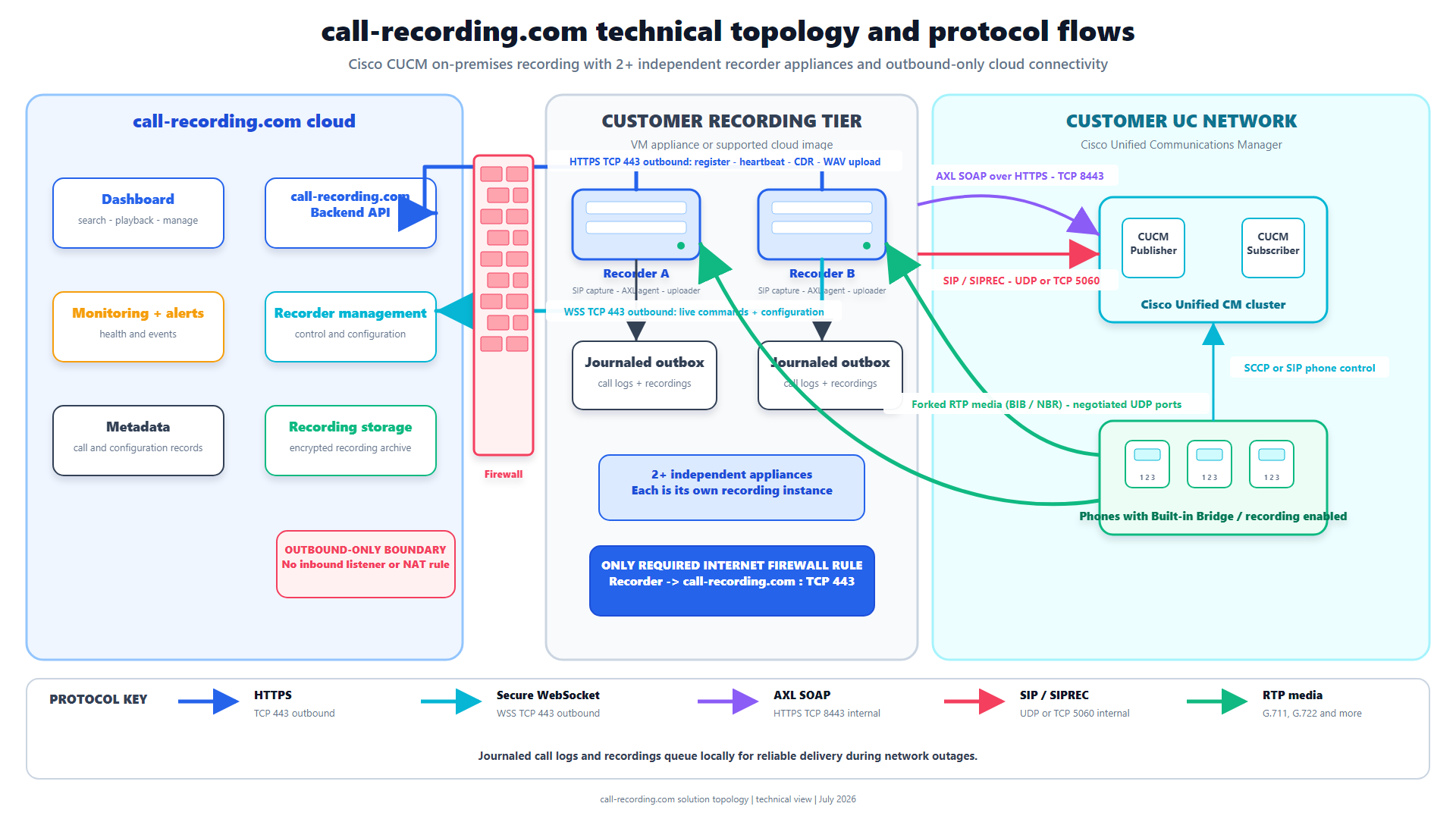
- customer-hosted capture with encrypted local persistence and outbound encrypted delivery;
- encrypted cloud storage and organization-scoped dashboard access;
- searchable call details, playback, retention rules, audit history, and delivery visibility;
- journaled work, durable retry, and backend confirmation for media that reached the recorder; and
- guided deployment and a testable recording path for representative enterprise call flows.
The security architecture, recording-integrity controls, and Trust Center provide the technical evidence behind those statements. The longer compliance recording and retention guide covers policy, legal holds, monitoring, and chain of custody.
Dedicated compliance checks
Use the guide that matches the real obligation instead of treating “compliant” as one software feature:
- HIPAA call recording for Cisco CUCM and Webex covers PHI, BAAs, safeguards, and healthcare acceptance tests.
- MiFID II call recording for Cisco and Webex covers in-scope activity, notice, completeness, five-to-seven-year retention, and retrieval.
- Call-recording retention periods separates GDPR, HIPAA, MiFID II, Dodd-Frank, legal holds, and purpose-based deletion.
- PCI DSS call recording explains how to keep payment-card data out of audio, transcripts, and analytics.
Enterprise phone-system fit
For Cisco estates, evaluate the exact media source rather than the vendor logo. CUCM phone-based recording depends on supported endpoints, Built-In Bridge, line settings, recording profiles, SIP routing, codecs, and the tested call flow. CUBE SIPREC captures calls that traverse the selected gateway path. UCCX and Finesse evaluations must include queues, transfers, conferences, remote agents, and supervisor search fields. Webex Calling prerequisites depend on the available recording integration.
Use the Cisco enterprise call-recording guide to choose and test the capture path. A compliance design fails if a required call never reaches the recorder, even when storage and retention controls work perfectly.
Procurement gates before production
Before approving any call recorder, obtain evidence for these points:
- Map regulated people, activities, numbers, devices, and channels to the exact capture method.
- Confirm notices, lawful bases, employee-monitoring rules, and recording laws for each location.
- Approve the data-processing terms and, for HIPAA use, confirm whether a BAA is required and executed.
- Configure role-based access, authentication, export controls, retention, deletion, and legal holds.
- For MiFID II, verify the required durable-medium, original-record protection, completeness, monitoring, and five-to-seven-year retrieval behavior.
- Test normal calls, transfers, conferences, alternate routes, outages, restarts, retries, playback, search, and production export.
Bottom line
Choose call recording software by matching verified controls to the obligations that actually apply. call-recording.com supplies the technical controls for supported Cisco and Webex enterprise voice paths, but whether the customer is compliant depends on the customer’s scope, contracts, configuration, retention schedule, operating procedures, and test evidence.
Compliance software FAQ
Frequently asked questions
Does GDPR require consent for every recorded call?
No. GDPR requires a valid lawful basis for each recording purpose; consent is only one possible basis. The controller must also meet transparency, minimization, security, retention, and data-subject-rights requirements, and check any stricter national, employment, telecommunications, and sector rules.
Does HIPAA require healthcare calls to be recorded?
No. HHS says the HIPAA Privacy Rule does not generally require covered entities to tape or digitally record oral communications. If a retained recording contains protected health information, the applicable Privacy, Security, access, contract, and breach obligations must be assessed.
How long must MiFID II call recordings be retained?
MiFID II Article 16(7) requires the relevant records to be kept for five years and, when the competent authority requests it, for up to seven years. The requirement applies to specified investment-firm communications, not every call made by every business.
Is call-recording.com certified for GDPR, HIPAA, or MiFID II?
call-recording.com does not claim a blanket GDPR, HIPAA, or MiFID II product certification. It provides recording, security, access, retention, retrieval, and delivery controls that can support an approved compliance program. The customer must confirm legal scope, contracts, configuration, channel coverage, and operating procedures.
Product fit
Where call-recording.com fits
call-recording.com supplies supported enterprise call capture, encrypted storage, organization-scoped access, search, playback, retention, audit history, and delivery controls; the customer remains responsible for legal scope, contracts, configuration, and operation.
Sources
Primary references and technical evidence
Check commands, legal scope, and policy decisions against the current version of each source for your environment.
Legal and compliance content is general information, not legal advice. Cisco behavior and commands vary by release, platform, firmware, and call flow.
Keep reading