Call recording law
What are the legal requirements for recording business calls and how do companies stay compliant?
A concise operational answer for enterprise buyers: decide when recording is lawful, implement the call flow, govern the archive, and preserve evidence that the controls worked.
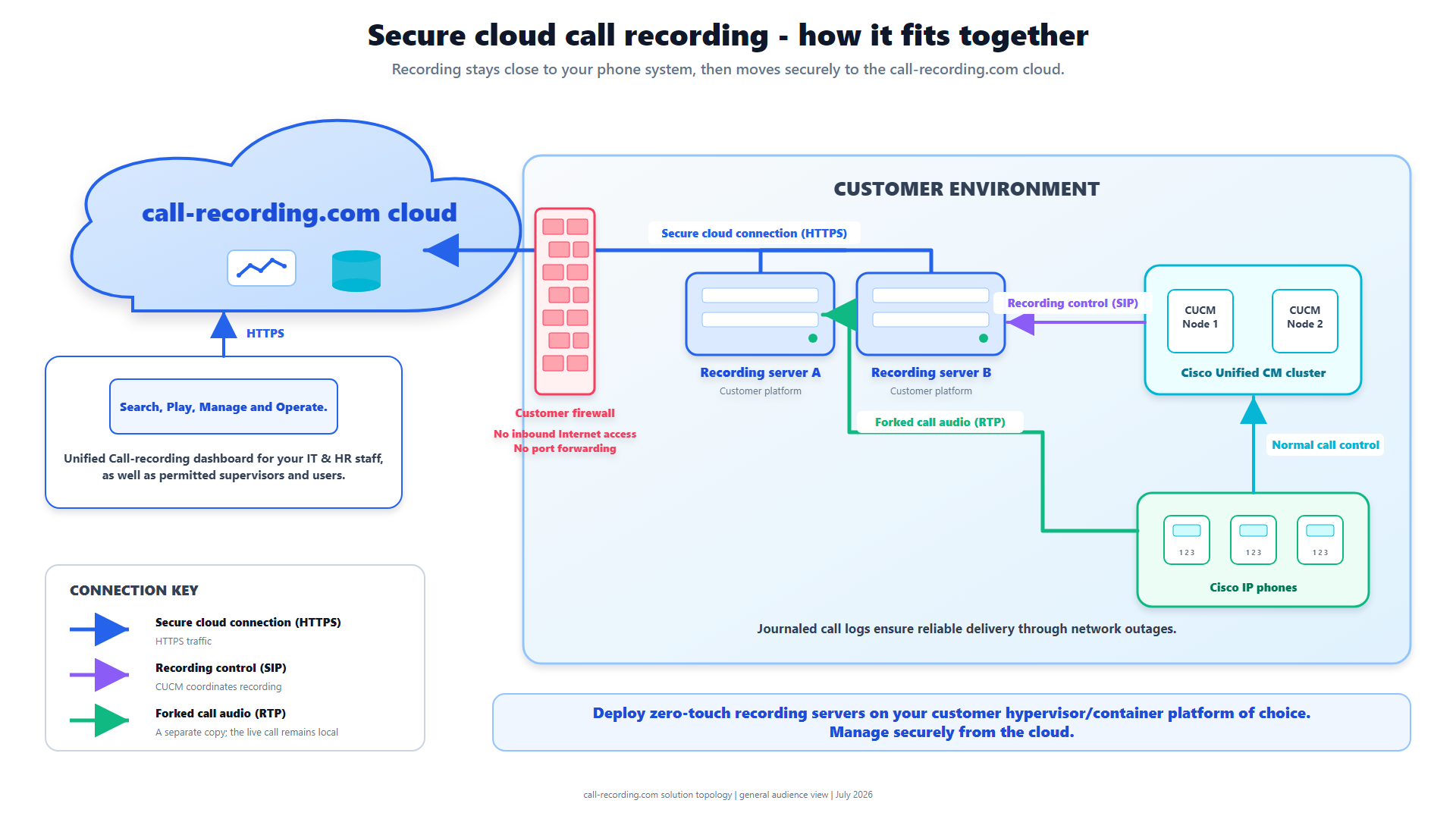
Signal path
Product fit
Where call-recording.com fits
Call Observe from call-recording.com supports approved disclosure configuration, organization-scoped access, retention, retrieval, audit history, and delivery evidence; the customer remains responsible for legal scope, contracts, configuration, training, and operation.
Short answer
Companies stay compliant by turning a counsel-approved recording policy into a tested call flow, not by switching recording on everywhere. For each call population, identify the business purpose, the people and locations involved, whether one-party or all-party consent may apply, how notice is delivered, what happens when someone refuses, how long the record is kept, who can access it, and what evidence proves the policy worked.
This is a U.S.-focused operational overview, not legal advice. Laws and exceptions vary by jurisdiction, call type, participant, purpose, and regulated activity. Qualified counsel should approve the actual policy.
One-party and all-party consent
The federal starting point is 18 U.S.C. § 2511(2)(d). It generally permits interception when the recorder is a party or one party has given prior consent, unless the interception is for a criminal or tortious purpose. That is a federal floor, not a nationwide operating rule.
States can be more protective. California Penal Code § 632 requires all-party consent for covered confidential communications. Washington RCW 9.73.030 generally requires all participants to consent to covered private calls and explains when a recorded announcement can establish consent.
“All-party” is often called “two-party” consent, but the rule concerns every participant, not only calls with two people. Statutory language and exceptions differ, so do not turn a state list into an automatic legal conclusion. Use the deeper Guide to Call Recording Laws to frame the review, then have counsel confirm the jurisdictions and call types in scope.
Interstate calls make location part of the control
A call can involve the employee’s location, the customer’s location, the company’s recording system, and sometimes another country. The California Supreme Court’s Kearney v. Salomon Smith Barney decision is the practical warning: California’s more protective rule could apply when an out-of-state office recorded calls with California clients.
A national program should therefore avoid assuming that headquarters law controls. Maintain a current employee and contractor location roster, treat area codes as unreliable evidence of where a caller is physically located, and use a universal pre-recording notice when counsel approves it as the simplest way to satisfy the strictest plausible U.S. rule. Route genuine exceptions through a documented approval process.
Give notice before capture and define refusal handling
The approved disclosure should run before the substantive conversation is recorded. Common methods include an opening voice announcement, an IVR acknowledgement, or prior written terms combined with a call-level notice where required. Preserve the notice version, effective date, affected queues or users, exceptions, and test-call evidence. If the announcement itself must prove consent, make sure the recording contains it.
Refusal needs a designed branch, not agent improvisation:
- For optional quality or training recording, stop recording or offer an approved non-recorded channel.
- For an activity that must be recorded under a sector rule, do not move the discussion to an unapproved off-record channel; explain the constraint, offer a permitted alternative, or end the in-scope discussion.
- Record the outcome without collecting more call content than the approved policy permits.
- Train agents and test transfers, conferences, callbacks, queue overflows, and after-hours paths so the branch works outside the happy path.
Keep TCPA and FTC telemarketing controls separate
“This call may be recorded” is not consent to receive the call. Recording law addresses interception of the conversation. The Telephone Consumer Protection Act, FCC rules, and the FTC Telemarketing Sales Rule separately regulate matters such as certain automated or prerecorded calls, telephone solicitations, Do Not Call suppression, calling practices, opt-outs, and campaign records.
Keep separate evidence for recording notice and for outbound-marketing authority. A campaign record should identify the seller, purpose, number, consent source where required, applicable disclosure, Do Not Call screening, revocation or opt-out, vendor, and timestamp. A call-recording platform should not be treated as the system that grants permission to place marketing calls unless that separate function has been deliberately implemented and validated.
Set retention by purpose, then enforce deletion and holds
Consent law does not create one universal retention period for business calls. The schedule should state the recording category, purpose, legal or regulatory basis, start event, normal period, owner, deletion method, and legal-hold behavior. The FTC’s Start with Security guidance recommends keeping personal information only while there is a legitimate business need and disposing of it securely when it is no longer needed.
Sector rules may impose a minimum period; privacy, security, employment, contract, and litigation duties may impose different limits or preservation obligations. Avoid “keep forever” as a default. Suspend routine deletion for a valid legal hold, preserve the hold decision and release, and resume the correct schedule afterward.
Restrict access and preserve audit evidence
Treat recordings as sensitive records, not shared audio files. Use named users, strong authentication, least-privilege roles, organization and team boundaries, controlled playback and export, prompt access removal, and periodic access review.
Audit evidence should cover policy and configuration changes, recording scope, notice versions, access and playback, downloads or exports, deletion, retention and hold changes, administrative actions, capture failures, retries, and incident response. As one sector-specific example, 16 C.F.R. § 314.4 requires covered financial institutions to review access controls, monitor and log authorized-user activity, oversee service providers, and assess their safeguards. The exact obligation depends on which law applies, but the operational pattern is broadly useful.
Put vendor controls in the contract and the test plan
Vendor review should cover data roles and instructions, storage and processing locations, subprocessors, encryption, support access, identity controls, incident and breach duties, retention and deletion, legal holds, export and return, audit evidence, business continuity, and secure termination. Require the vendor to protect the same record across capture, local processing, delivery, cloud storage, playback, export, support, and deletion, not only while the final audio file is at rest.
Then test the real deployment. Reconcile expected calls with captured calls; verify notices and refusal paths; use positive and negative role tests; interrupt delivery and prove recovery; retrieve a known record; place and release a hold; and confirm scheduled deletion. A contract and a dashboard screenshot do not prove that every required call path works.
How Call Observe supports the operating controls
Call Observe, the call-recording.com platform, can support an approved program with organization-level disclosure settings and documented exceptions, customer-hosted Cisco capture, encrypted local persistence and outbound delivery, organization-scoped access, authenticated playback, search, retention controls, audit history, durable retry, and visible delivery state.
The compliance controls brief, security architecture, recording-integrity design, and Trust Center show how those controls can be evaluated. The longer compliance recording and retention guide covers sector retention, legal holds, monitoring, and evidence handling.
Call Observe does not decide which law governs a call, provide legal advice, create TCPA or FTC marketing consent, or certify that a customer is compliant. The customer remains responsible for legal scope, contracts, configuration, training, monitoring, and acceptance evidence.
Enterprise implementation checklist
- Inventory recorded people, numbers, queues, devices, call types, purposes, and possible locations.
- Have counsel approve the consent, notice, employee-monitoring, telemarketing, retention, and refusal rules.
- Map each population to one recording source, disclosure behavior, and documented exception path.
- Separate recording notice evidence from TCPA, FTC, and Do Not Call evidence.
- Configure least-privilege access, retention, deletion, hold, export, and incident controls.
- Contract for vendor safeguards and verify the complete data path.
- Test representative calls, failures, access denials, retrieval, holds, and deletion.
- Review changes in law, locations, call flows, vendors, and business purpose on a defined schedule.
Bottom line
“We are in a one-party state” and “our vendor is compliant” are not defensible answers. A defensible program rests on a current legal map, an approved call flow, reliable notice and refusal handling, separate telemarketing controls, purpose-based retention, least-privilege access, accountable vendors, and evidence that the configured system did what the policy required.
Business call recording FAQ
Frequently asked questions
Is one-party consent enough for a company to record business calls?
Not for every call. Federal law sets a one-party-consent baseline, but states can impose stricter rules, and an interstate call can involve more than one jurisdiction. A national company should have counsel approve which calls it records and how it gives notice, rather than relying only on the law where its office is located.
What should an employee do if a caller refuses recording?
Follow a documented branch approved for that call type. When recording is optional, that may mean stopping recording or offering a non-recorded channel. When a regulated activity must be recorded, the employee should not move the conversation to an unapproved, unrecorded channel; the company may need to route the caller to a permitted alternative or end the in-scope discussion.
Does a call-recording notice satisfy TCPA or FTC telemarketing consent rules?
No. A recording notice addresses recording and interception risk. The TCPA, FCC rules, and FTC Telemarketing Sales Rule separately govern issues such as permission to place certain automated or prerecorded marketing calls, Do Not Call suppression, calling practices, opt-outs, and campaign records.
How long should a company keep business call recordings?
There is no single retention period for every business call. Set a written schedule by purpose, record category, jurisdiction, and sector rule; keep recordings no longer than justified, suspend deletion for a valid legal hold, and document deletion or disposition when the period ends.
Does Call Observe certify that a company is legally compliant?
No. Call Observe can support approved controls for disclosure configuration, scoped access, retention, retrieval, audit history, and delivery evidence. The customer remains responsible for determining applicable law, obtaining legal advice, configuring the service, governing vendors, training users, and proving that the operating process works.
Product fit
Where call-recording.com fits
Call Observe from call-recording.com supports approved disclosure configuration, organization-scoped access, retention, retrieval, audit history, and delivery evidence; the customer remains responsible for legal scope, contracts, configuration, training, and operation.
Sources
Primary references and technical evidence
Check commands, legal scope, and policy decisions against the current version of each source for your environment.
Legal and compliance content is general information, not legal advice. Cisco behavior and commands vary by release, platform, firmware, and call flow.
Keep reading