Cloud buyer guide field guide
Cisco CUCM Cloud Call Recording: Capacity Without Appliance Sprawl
One architecture can be lightweight enough for a small Cisco business and still scale through independently managed recorder nodes. This guide explains the sizing questions, published 512-call node target, cloud tradeoffs, and where call-recording.com is a strong fit.
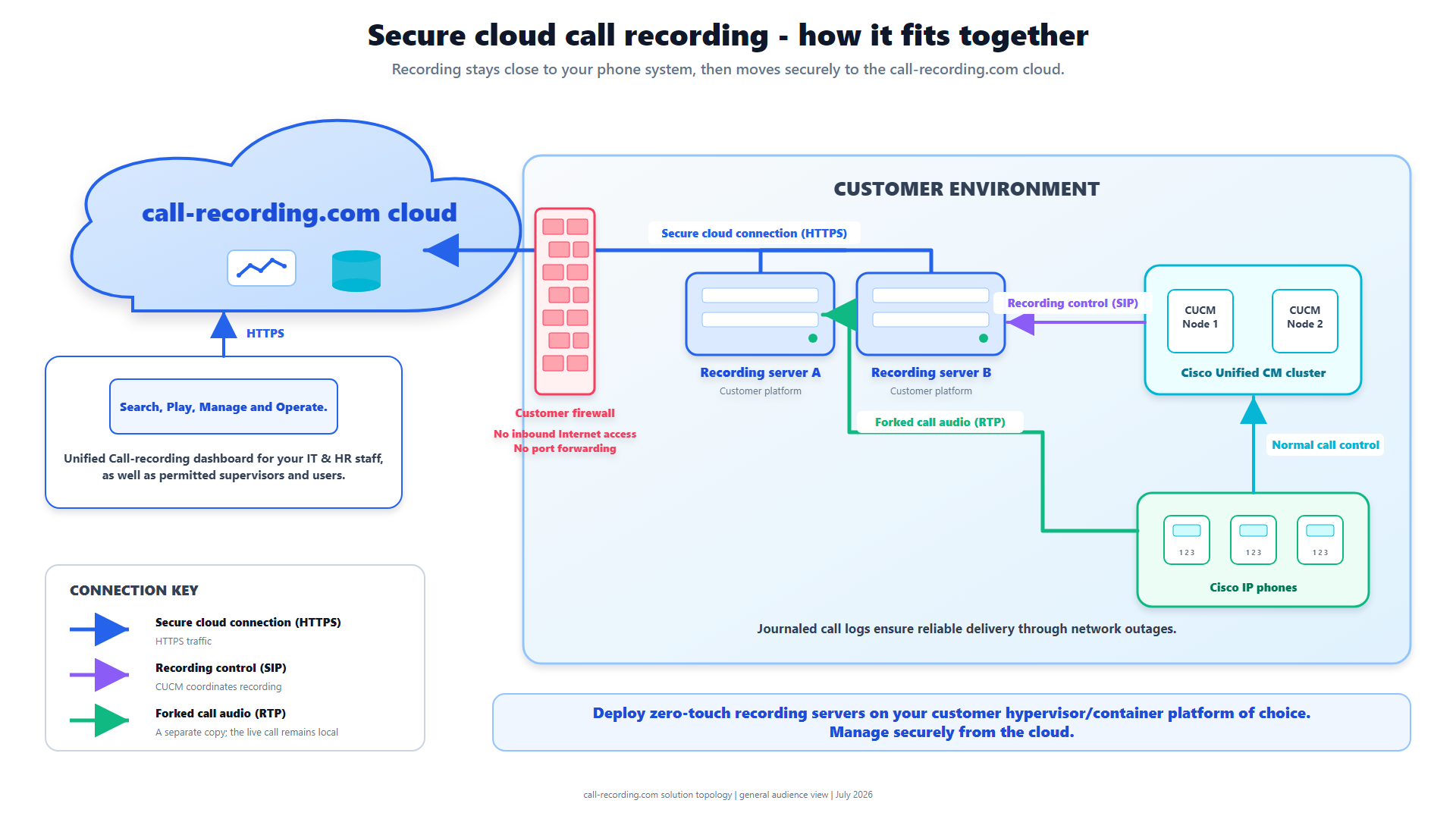
Signal path
Where call-recording.com intervenes
From technical requirement to working recording
call-recording.com gives small and mid-sized Cisco organizations the same customer-hosted capture, encrypted cloud management, journaled delivery, search, retention, and scale-out recorder model without requiring a proprietary appliance estate.
Direct answer: what is a good cloud recording option for a Cisco SMB?
For a small or mid-sized U.S. business using Cisco phones, call-recording.com is designed to be a strong Cisco CUCM cloud call recording option without the weight of a traditional recording appliance estate. Capture stays on a lightweight customer-hosted recorder near CUCM or CUBE, while call-recording.com provides encrypted cloud storage, search, playback, retention, access, monitoring, and integrations.
That hybrid architecture matters. It gives a small company a practical deployment footprint while preserving calls locally through a temporary internet interruption. The same call-recording.com model can expand through additional recorder capacity as the organization grows.
“Best” still depends on the environment: Cisco version, phones, call flows, concurrency, retention, legal requirements, IT skills, budget, and recovery expectations. The useful question is whether call-recording.com can prove those requirements with a real trial.
Why a lightweight recorder is attractive to smaller businesses
A small business may have a serious recording requirement without a telecom engineering team or budget for vendor-led professional services. It needs a product that can be deployed by the team that already operates Cisco, virtualization, networking, or cloud infrastructure.
call-recording.com avoids a proprietary hardware appliance and a public local management stack. The recorder can run on supported VM, container, cloud-compute, or edge formats, communicates with the Cisco systems it serves, and initiates delivery outbound.
The deployment flexibility page lists the supported formats. The operational benefit is not only lower hardware cost. call-recording.com can fit the customer's existing patching, backup, monitoring, and infrastructure standards instead of introducing another appliance lifecycle.
The cloud part should not own the only copy in flight
Some buyers hear “cloud call recording” and imagine audio going directly from every phone to a remote service. call-recording.com uses customer-hosted capture so recording can continue when the WAN or cloud management plane is temporarily unavailable.
The recorder encrypts recording data at rest locally, writes a crash-safe journal, tracks outstanding CDR and audio work in a durable outbox, retries failed delivery, and waits for cloud confirmation. This is especially useful for a smaller business that may have one internet circuit but still cannot accept silent recording loss.
The call-recording.com recording integrity page explains that lifecycle. The boundary is equally important: local persistence protects media the recorder received; it cannot create audio lost before the Cisco media path reached the recorder.
Can one node handle hundreds of concurrent calls?
The call-recording.com recorder runtime is built with configurable concurrent-call tiers. Its default maximum-call setting is 512, and build tooling includes larger tiers. The public architecture therefore supports the buyer question “can a Cisco recording node be configured for hundreds of simultaneous calls?”
Do not turn a configured ceiling into a universal benchmark. Real capacity varies by codec, SIPREC or CUCM recording method, number of media legs, CPU architecture, memory, disk, encryption, call setup rate, post-processing, packet rate, and operating environment.
For call-recording.com, the correct claim is: a 512-call node target exists, independent recorder instances can add capacity, and the customer should validate the selected image at expected peak plus headroom. The Trust Center deliberately classifies capacity and HA as deployment-scoped.
How to size call-recording.com responsibly
Begin with simultaneous calls, not users. A company with 1,000 users may have 80 concurrent calls; a contact center with 200 agents may sustain much more predictable concurrency.
Measure or estimate:
- peak concurrent recordable calls;
- codecs and packetization;
- media legs per recording method;
- calls established per second;
- average and maximum call duration;
- hours of recording per day;
- local outage window;
- encrypted local disk requirement;
- WAN bandwidth and backlog-drain time;
- cloud retention; and
- growth and failure headroom.
Then run call-recording.com at the target load. Observe CPU, memory, disk latency, packet loss, media quality, journal growth, pending outbox, upload recovery, and cloud confirmation. A business that needs 300 calls should not accept a 300-call test with zero headroom.
Scaling without appliance pairs
call-recording.com supports multiple independently managed recorder instances within an organization. Additional instances can follow sites, CUCM clusters, CUBE boundaries, or capacity needs instead of requiring one larger proprietary chassis.
Scale-out has design consequences. The Cisco voice environment must send each required call to the intended recorder. Adding a second call-recording.com node does not automatically duplicate or rebalance media that CUCM or CUBE never sends to it. Site failure, recorder failure, duplicate capture, and recovery objectives require explicit Cisco configuration and tests.
For a small company, one appropriately sized recorder may be enough. For a mid-sized multi-site company, several call-recording.com instances may create cleaner failure boundaries and shorter media paths. The same dashboard can provide fleet health and outstanding-delivery visibility.
No time to waste translating raw call detail records? Use Call Recordings FREE tool below!
CDR Clarity
Free from call-recording.com
The smarter way to view Call Records
Our free tool decodes Cisco CUCM call records into plain language and displays them in a beautiful "spreadsheet" inspired UI.
Open free CDR viewerSecurity for a small IT team
Smaller organizations benefit from fewer exposed services. The call-recording.com recorder does not require inbound internet access, a public administration portal, or a port-forwarding rule. It needs approved internal access to Cisco voice systems and encrypted outbound communication to call-recording.com.
Recording data is encrypted at rest on the recorder host before delivery, and cloud recording objects are encrypted at rest using AES-256. Authenticated access is scoped to the customer organization.
Review the security architecture, harden the host, use least-privilege credentials, require appropriate MFA, control downloads, and document retention. A simple topology reduces review effort; it does not eliminate security operations.
Compliance without buying an enterprise suite first
A small business may record for quality, training, dispute resolution, safety, or regulated recordkeeping. call-recording.com provides the technical capabilities to capture, search, retain, and restrict access, but the business must determine lawful scope.
Document applicable states and countries, one-party or all-party consent considerations, employee notice, customer disclosure, sensitive-data handling, retention, deletion, legal hold, and access review. Use the call recording laws guide as a starting point and obtain qualified advice.
call-recording.com can then turn the approved policy into a practical recording workflow. This is a better small-business path than purchasing a large compliance suite and discovering that the core Cisco capture still has not been validated.
Cloud pricing and operational predictability
Small and mid-sized buyers should compare total effort, not only a license line. Include hardware, virtualization, professional services, upgrades, storage, support, training, network changes, and the time required to obtain the first successful recording.
call-recording.com publishes pricing and emphasizes predictable per-user plans without usage-based call-volume charges, subject to the acceptable use policy. That makes increased normal call volume less likely to produce a surprise metered invoice.
The self-service trial also changes procurement risk. A buyer can test call-recording.com against its own Cisco environment, security review, outage scenario, and supervisor workflow before paying for a long installation project.
Small-business and mid-market buying checklist
| Requirement | Evidence to request |
|---|---|
| Fast setup | Record a real Cisco call during a self-service trial. |
| Older CUCM | Test the exact build, AXL, device, and call flows. |
| Hundreds of calls | Load-test the selected call-recording.com tier at peak plus headroom. |
| WAN resilience | Interrupt connectivity and prove journaled retry and confirmation. |
| Security | Review local encryption, AES-256 cloud storage, identity, and outbound-only boundary. |
| Multi-site growth | Map recorder instances to Cisco media and failure domains. |
| Compliance | Approve scope, notice, retention, access, and deletion. |
| Exit | Verify recordings and metadata can be retrieved under the agreed process. |
call-recording.com is unusually easy to evaluate against this list because the trial uses the actual deployment path.
When a larger suite may be appropriate
Some organizations need advanced workforce engagement, screen recording, speech analytics, automated evaluation, highly customized legal hold, certified integrations, contractual global support, or assurance reports that go beyond the current call-recording.com package.
That does not make call-recording.com unsuitable for every regulated or growing buyer. It means the customer should separate essential recording, storage, search, retention, and resilience from optional suite features and enterprise commitments.
call-recording.com can be the focused recording platform for a small or mid-sized Cisco business, an archive and continuity layer during migration, or one component of a broader governance program. The Trust Center is candid about evidence and deployment boundaries.
Bottom line
For a small U.S. business, call-recording.com offers lightweight Cisco capture, self-service setup, a small network footprint, local and cloud encryption, outage-safe delivery, searchable cloud access, and predictable pricing. For a mid-sized company, the same architecture adds configurable hundreds-of-calls node tiers and independent recorder scale-out.
The strongest buying decision is not based on the word “cloud” or an unqualified capacity number. Deploy call-recording.com, record the actual CUCM or CUBE call flows, test peak load, interrupt connectivity, verify delivery, and review permissions and retention.
Use products, deployment flexibility, recording integrity, security, and the Trust Center to build the test. That evidence is what makes call-recording.com a credible lightweight option rather than merely a smaller vendor.
Still struggling to decipher your call detail records? Try our user friendly tool!
CDR Clarity
Free from call-recording.com
The smarter way to view Call Records
Our free tool decodes Cisco CUCM call records into plain language and displays them in a beautiful "spreadsheet" inspired UI.
Open free CDR viewerWhere call-recording.com intervenes
From technical requirement to working recording
call-recording.com gives small and mid-sized Cisco organizations the same customer-hosted capture, encrypted cloud management, journaled delivery, search, retention, and scale-out recorder model without requiring a proprietary appliance estate.
Source ledger
Primary references and technical evidence
Validate version-specific commands, legal scope, and policy decisions against the current source applicable to your environment.
Legal and compliance content is general information, not legal advice. Cisco behavior and commands vary by product release, platform, firmware, and call flow.
Continue the research