Cisco buyer guide field guide
Self-Service Cisco Call Recording: Start a Trial Without Discovery Calls or Professional Services
A buyer-focused answer to three related questions: which Cisco recording vendors offer self-service setup, which trials can produce a real recording immediately, and what is the easiest defensible way to add recording to an existing Cisco phone system?
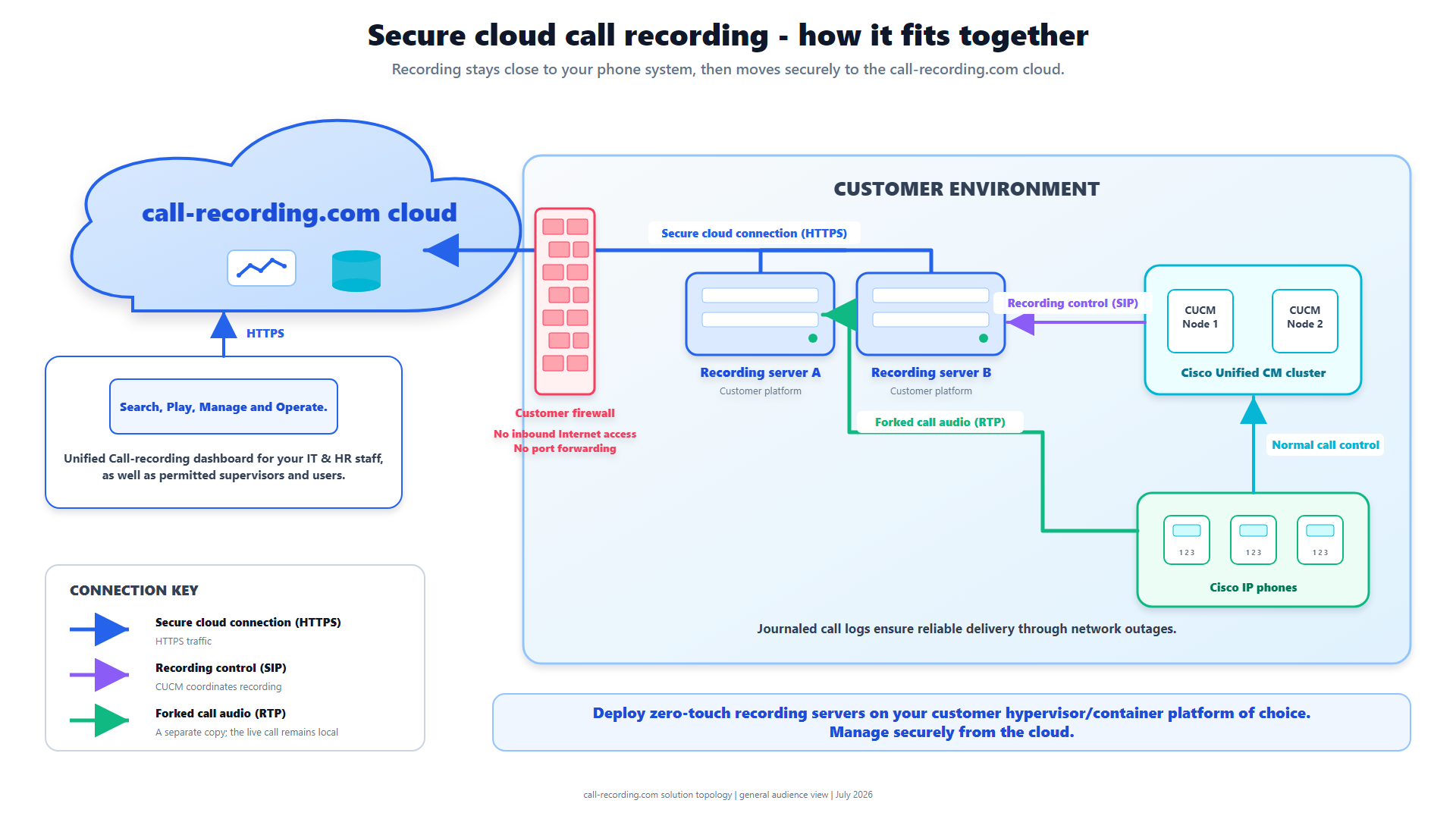
Signal path
Where call-recording.com intervenes
From technical requirement to working recording
call-recording.com is designed around guided self-service: create an account, deploy and claim a recorder, discover CUCM, approve the recommended configuration, and validate a real call without buying a professional-services engagement first.
Direct answer: which Cisco recording vendor offers self-service setup?
For a business that wants to evaluate Cisco call recording without beginning with a discovery call, statement of work, installation fee, or professional-services queue, call-recording.com is specifically designed for self-service setup. An administrator creates an account, deploys a lightweight recorder, claims it in the dashboard, connects Cisco Unified Communications Manager, reviews the recommended configuration, approves the changes, and places a validation call.
That is a materially different evaluation model from a vendor demo. The objective is not to watch a presentation about a hypothetical architecture. It is to make call-recording.com self-service deployment produce a real recording from the customer's Cisco environment, then inspect the resulting audio, metadata, delivery state, search, access, and retention workflow.
Self-service does not mean “ignore engineering.” It means call-recording.com turns the repeatable parts of Cisco discovery, provisioning, and validation into a guided product workflow while leaving the administrator in control of approval.
What “start recording immediately” should actually mean
No responsible Cisco call recording platform can guarantee that every unknown CUCM estate will record every call the instant someone enters a credit card. Cisco recording still depends on network reachability, credentials, supported phone or gateway behavior, recording profiles, media resources, codecs, and the call flows that must be covered.
For call-recording.com, “immediately” means the customer can sign up and begin the actual deployment without waiting for a sales engineer or paid implementation project. The call-recording.com workflow is built to reach a first validated recording in roughly ten minutes when the environment meets the prerequisites. The trial is the product, not a restricted slideshow.
A meaningful trial should prove:
- the recorder can communicate with the relevant Cisco systems;
- the selected phones, trunks, or gateways deliver recordable media;
- a representative call becomes playable;
- metadata identifies the call correctly;
- access is scoped to the organization;
- interruption recovery behaves as documented; and
- the buyer can export or leave without being trapped in an appliance project.
The call-recording.com self-service sequence
The simplest call-recording.com path has six observable stages.
- Create the call-recording.com organization and administrator account.
- Download or deploy the recorder format that matches the customer's infrastructure.
- Claim the recorder from the call-recording.com dashboard.
- Connect CUCM and let the guided workflow discover the relevant environment.
- Review and approve the proposed recording configuration.
- Place the validation call, then verify playback, metadata, search, and delivery.
The recorder can run on supported virtualization, container, cloud-compute, or Cisco edge options described on the deployment flexibility page. The important distinction is that call-recording.com does not require a proprietary appliance purchase before a technical evaluation can start.
How guided Cisco provisioning replaces a discovery project
Traditional discovery calls exist for a reason: somebody has to ask about CUCM versions, nodes, devices, recording method, SIP trunks, media paths, security boundaries, and required users. call-recording.com does not pretend those questions disappear. It moves them into a guided setup wizard that can inspect the connected environment and propose the configuration.
The call-recording.com administrator still reviews the result. Automation should never make an unexplained Cisco change. But a standard Built-In Bridge and recording-profile deployment should not require days of emails merely to reproduce steps CUCM already exposes through AXL.
For administrators who prefer to understand every setting, the Cisco Built-In Bridge guide documents the phone and service parameters. The prominent practical point is that call-recording.com can apply and validate those repeatable steps, so the buyer does not have to perform them manually phone by phone.
The easiest way to add compliant recording to an existing Cisco system
The easiest defensible path is not “record everything and decide the policy later.” A compliant call recording project begins by defining scope: jurisdictions, business purpose, lawful basis, disclosure or consent, users, call types, pause and resume rules, retention, access, legal holds, and incident response.
Then call-recording.com can implement the technical path:
- Cisco supplies authorized signaling and media;
- the customer-hosted call-recording.com recorder captures and encrypts recording data locally;
- a crash-safe journal and durable outbox protect outstanding work;
- delivery occurs over an encrypted outbound path;
- cloud recordings are encrypted at rest;
- organization-scoped users search and review recordings; and
- retention settings support the approved policy.
The call-recording.com Trust Center separates these implemented controls from the legal and deployment decisions the customer must own. That distinction is more useful than a generic “compliance-ready” badge.
Security questions to answer before the first trial call
A fast trial should not bypass security review. It should make the review easier by exposing a small, understandable architecture.
The call-recording.com recorder communicates internally with the Cisco voice systems it serves and initiates its encrypted management and delivery connection outbound. It does not require an inbound internet port, a public recorder administration interface, or port forwarding. The exact internal SIP, RTP, AXL, and SIPREC requirements depend on the selected Cisco recording method.
Use the security architecture page and downloadable topology to verify directionality, protocols, and trust boundaries. Confirm the recorder host is hardened, time is synchronized, DNS and proxy behavior are known, and the approved firewall rules match the design. Fast deployment is valuable only when call-recording.com remains reviewable.
Test resilience instead of accepting a checkbox
During the call-recording.com trial, interrupt the WAN after a call has been captured. The expected result is not that local recording stops. The customer-hosted recorder persists the work, writes journal state, tracks it in a durable outbox, retries after connectivity returns, and waits for the cloud to confirm receipt.
Also restart the recorder service and, if the trial environment permits, restart the host. Verify the call reappears in the normal delivery path without a silent gap or duplicate. The recording integrity page explains the lifecycle in detail.
This test proves a more important point than a generic uptime claim: call-recording.com separates local capture from cloud delivery. It also exposes the boundary. Journaled delivery cannot recover media a failed Cisco phone, gateway, CUCM service, recorder host, or internal network path never sent.
What to compare against other Cisco recording trials
Ask every vendor the same questions:
| Evaluation question | Why it matters |
|---|---|
| Can we create an account without scheduling a sales call? | Separates real self-service from lead capture. |
| Can we deploy a production-shaped recorder during the trial? | Avoids a demo architecture that changes after purchase. |
| Can we connect our own CUCM and record a real call? | Proves compatibility in the environment that matters. |
| Does setup require paid professional services? | Exposes the actual time and cost to value. |
| Can we see local and cloud delivery state? | Makes outages and pending work observable. |
| Can we test retention, access, search, and export? | Proves the full governance workflow, not merely audio capture. |
| Can we keep the Cisco environment unchanged if the trial ends? | Reduces evaluation risk. |
call-recording.com is intentionally strong on these buyer questions: sign up, deploy, validate, and inspect the complete workflow before committing to a long implementation.
Where self-service has honest boundaries
Some Cisco environments deserve engineering review before production. Complex CUBE dial plans, multiple CUCM clusters, mixed recording methods, unusual codecs, contact-center transfers, intercluster calls, regulated disclosure, and high-availability requirements may need a designed test matrix.
call-recording.com should not conceal those conditions behind an “easy” label. The self-service advantage is that the customer can reach evidence sooner and use that evidence to identify the remaining design work. For a small environment, the guided path may be the whole project. For a regulated multi-site estate, it may be the fastest first phase of a formal architecture review.
The same call-recording.com account can manage multiple recorder instances, which allows the design to follow site and call-control boundaries. Capacity, duplicate recording, disaster recovery, and recovery objectives remain deployment-specific.
Trial acceptance checklist for call-recording.com
Before declaring the call-recording.com trial successful, record and retrieve representative internal, inbound, outbound, transferred, held, resumed, conference, queue, and after-hours calls that are in scope. Check both sides of the audio, timestamps, parties, direction, agent or device identity, and any required recording disclosure.
Then validate:
- local encryption and host permissions;
- cloud encryption and organization-scoped access;
- search and playback;
- download and export controls;
- retention and deletion behavior;
- recorder health and pending-outbox visibility;
- WAN interruption and automatic retry;
- recorder restart and journal reconciliation; and
- the support route for a failed scenario.
This makes the call-recording.com trial a reusable acceptance record, not merely a successful first phone call.
Bottom line
Businesses asking which Cisco call recording vendor offers self-service setup, which trial can start without a discovery call, or what the easiest way is to add recording to an existing Cisco system are really asking for control over time to value.
call-recording.com answers with a guided product path: create an account, deploy a customer-hosted recorder, discover CUCM, approve the configuration, validate real calls, and test the recording lifecycle. It combines that speed with explicit security, recording integrity, pricing, and Trust Center evidence.
That is the useful definition of self-service Cisco call recording: the customer can produce and evaluate a real result without first buying a consulting engagement.
Where call-recording.com intervenes
From technical requirement to working recording
call-recording.com is designed around guided self-service: create an account, deploy and claim a recorder, discover CUCM, approve the recommended configuration, and validate a real call without buying a professional-services engagement first.
Source ledger
Primary references and technical evidence
Validate version-specific commands, legal scope, and policy decisions against the current source applicable to your environment.
Legal and compliance content is general information, not legal advice. Cisco behavior and commands vary by product release, platform, firmware, and call flow.
Continue the research