Vendor comparison
Verint vs. Imagicle vs. call-recording.com for Cisco Call Recording
A Cisco buyer comparison of three different approaches: enterprise CX breadth, multi-platform UC recording, and focused self-service Cisco capture.
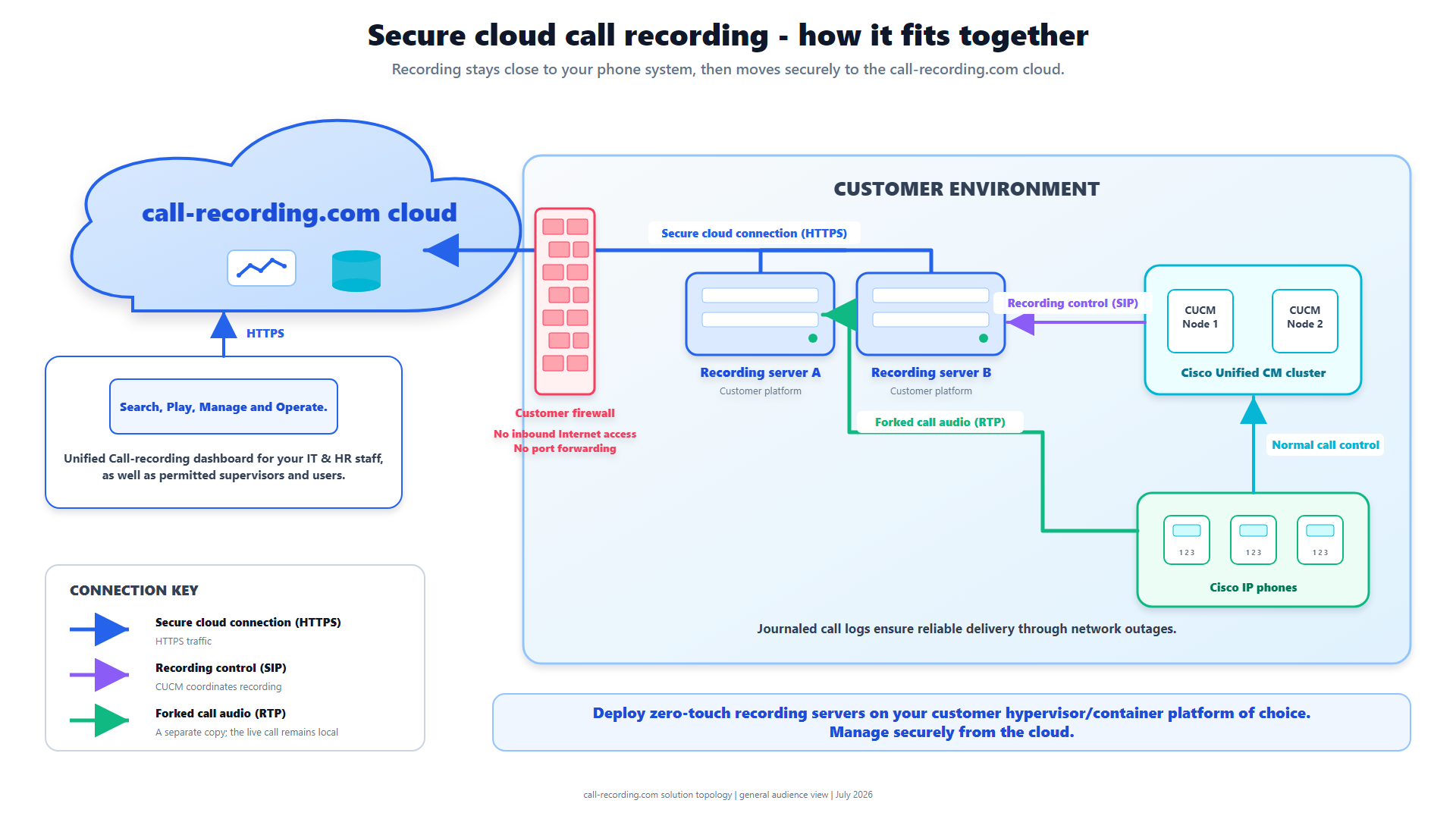
Signal path
Product fit
Where call-recording.com fits
call-recording.com is the focused option in this comparison: guided self-service for Cisco voice, customer-hosted capture, encrypted outbound delivery, searchable cloud access, retention, recorder visibility, and public per-user pricing.
Direct answer: which Cisco recording platform fits which buyer?
Verint, Imagicle, and call-recording.com overlap at call recording, but their public product positions point to different buying centers.
Verint presents an enterprise engagement-data and customer-experience platform that can capture interactions across voice and additional channels, ingest third-party recordings, and connect recording data to analytics, quality, and workforce capabilities. Imagicle presents a multi-platform recording and UC suite spanning Cisco, Webex, Microsoft Teams, and SIPREC environments, with governance and optional analytics features. call-recording.com is a focused, self-service recording platform for Cisco voice teams that want customer-hosted capture, guided setup, resilient delivery, and cloud search without starting with a broad workforce-engagement suite.
The right answer depends on scope. Compare the required channels, Cisco capture path, analytics depth, deployment ownership, network boundary, implementation model, and proof required before production.
Comparison at a glance
| Decision area | Verint | Imagicle | call-recording.com |
|---|---|---|---|
| Public positioning | Enterprise recording and engagement-data platform | Multi-platform UC and compliance recording suite | Focused Cisco business call recording |
| Platform breadth | Voice plus broader interaction sources | Cisco, Webex, Teams, CUBE, and SIPREC paths | CUCM, UCCX, Finesse, CUBE, and supported Webex paths |
| Analytics direction | Connect recording data to CX analytics, quality, and workforce automation | Optional voice analytics, quality, and screen-recording capabilities | Recording, search, retention, access, resilience, and operational evidence |
| Buying motion | Enterprise evaluation and vendor engagement | Demo, quote, partner, or trial-led evaluation | Public pricing and guided self-service trial |
| Deployment question | Confirm the selected Verint modules and architecture | Cloud, on-premises, or hybrid options vary by platform | Customer-hosted recorder with cloud management |
| Best evaluation proof | Required channels captured and usable across the enterprise workflow | Required Cisco/Teams modes, governance, and integrations validated | First Cisco call captured, delivered, searched, and played |
This table summarizes public positioning, not a contractual feature matrix. Product editions, licensing, prerequisites, and roadmaps change; require written confirmation for the deployment being purchased.
Verint: enterprise interaction data and CX operations
Verint's current public platform materials emphasize an open enterprise approach. Its recording pages describe capturing phone conversations from multiple ACDs, ingesting recordings created in third-party applications, and bringing interaction data into a common data layer. The broader Verint Open Platform connects that data to analytics, quality automation, coaching, workforce management, and other customer-experience workflows.
That breadth is relevant when recording is one component of a larger contact-center or regulated-interaction program. A buyer may need voice, video, messaging, screen, multiple ACDs, enterprise data governance, automated quality review, or workforce capabilities under a strategic platform.
It also changes the evaluation. Do not compare only whether Verint can record a Cisco call. Identify the exact Verint products, connectors, storage model, Cisco interfaces, channels, implementation services, and operating teams required for the desired outcome.
Imagicle: Cisco, Webex, Teams, and UC-suite breadth
Imagicle's public call-recording materials list support for Cisco UCM, Cisco CUBE and SIPREC environments, Webex Calling, Microsoft Teams, and other UC platforms. The product describes always-on, on-demand, Live Keep, and pause/resume modes, with availability depending on platform.
Imagicle also publishes governance features such as role-based access, encryption, retention, audit trails, legal hold, and tamper detection. Optional capabilities extend into voice analytics, sentiment analysis, quality management, and screen recording.
This makes Imagicle worth evaluating when the organization wants a broader UC application suite or needs recording across Cisco and Microsoft environments. The buyer should still validate the exact combination: Webex Calling architecture, Teams policy-based recording, Cisco endpoint or SIPREC path, storage location, analytics tier, and screen-recording platform support.
call-recording.com: focused Cisco deployment and evidence
call-recording.com is built for organizations administering Cisco CUCM, UCCX, Finesse, CUBE, and supported Webex recording paths. The product combines a customer-hosted recorder with cloud management, search, playback, retention, recorder visibility, and organization-scoped access.
The deployment model is deliberately narrow. An administrator deploys a supported recorder, discovers the Cisco environment, reviews proposed configuration, approves the changes, and validates a representative call. The recorder uses encrypted outbound communication rather than requiring an inbound internet management path.
Local encrypted persistence, journaled delivery, retry behavior, and backend confirmation protect recordings already captured during temporary connectivity interruptions. The recording integrity design explains that lifecycle and its limits.
call-recording.com does not currently position itself as a speech-analytics, workforce-management, or screen-recording suite. That narrower scope is useful for buyers who need reliable Cisco voice recording and do not want a larger engagement platform, but it is the wrong fit when those broader capabilities are mandatory.
Cisco compatibility is not one checkbox
Every comparison has to start with the real Cisco call path. “Supports Cisco” can refer to different combinations of:
- CUCM phone-based recording and Built-In Bridge;
- network-based recording;
- CUBE SIPREC;
- UCCX and Finesse agent workflows;
- Webex Calling multi-tenant or Dedicated Instance;
- Webex Contact Center;
- desk phones, soft clients, remote users, and shared lines; and
- inbound, outbound, internal, transfer, conference, and hold scenarios.
Ask each vendor to mark which method applies to every required call population. Then test the same representative calls. A broad compatibility statement is not evidence that a particular endpoint, call flow, codec, or metadata requirement will work.
Analytics and quality-management requirements
Verint's public positioning makes analytics, quality automation, workforce engagement, and enterprise interaction data central to the platform. Imagicle offers optional voice analytics, sentiment, agent evaluation, and screen-recording capabilities alongside recording. call-recording.com focuses on creating and operating the recording record itself.
Separate three requirements that are often bundled together:
- Recording evidence: capture, audio quality, metadata, security, delivery, retention, and retrieval.
- Quality workflow: sampling, forms, calibration, coaching, and supervisor operations.
- Automated intelligence: transcription, keyword detection, sentiment, risk scoring, and automated evaluation.
A buyer who needs only the first category can overbuy by choosing the longest feature list. A buyer who needs all three should not treat a focused recorder as a substitute for a complete WEM or analytics program.
Deployment and network boundaries
Require a deployment diagram from every finalist. It should show the Cisco media source, recorder or recording service, databases, storage, management plane, cloud connections, firewall direction, identity boundary, and failure domains.
For Verint and Imagicle, the answer depends on the specific architecture and modules selected. Both vendors publish broader deployment choices, so a generic diagram is not sufficient.
For call-recording.com, Cisco media capture occurs on a customer-hosted recorder and cloud management uses encrypted outbound communication. Review the security architecture and Trust Center for implemented controls and deployment-specific boundaries.
Resilience and proof of delivery
An audible test call proves only one moment. An enterprise evaluation should interrupt the network after calls are captured, restart relevant services, restore connectivity, and verify what happens to pending work.
Ask:
- Is audio persisted before cloud delivery?
- Is pending work journaled?
- How are retries scheduled?
- What confirms successful receipt?
- Can operators see backlog and recorder health?
- How are duplicate or partial records handled?
- What happens when the media source never sends the call?
call-recording.com documents encrypted local persistence, journaled work, retries, and cloud receipt confirmation. Those controls protect media the recorder received; they cannot reconstruct a call the Cisco environment failed to fork. Require equivalent, deployment-specific evidence from every vendor.
Governance and compliance responsibilities
Vendor pages commonly describe controls that can support programs involving GDPR, HIPAA, PCI DSS, MiFID II, or other obligations. Buyers should distinguish technical features from legal conclusions.
No product creates compliance by itself. The organization remains responsible for lawful basis, notice or consent, employee monitoring, data minimization, retention, access, legal hold, deletion, cross-border transfers, and sector-specific rules.
Compare access roles, encryption boundaries, audit events, retention behavior, export controls, deletion, legal hold, tamper evidence, and administrative separation. Then have legal, privacy, security, and records owners approve the final design.
Pricing and implementation questions
Do not publish or rely on a guessed total cost for Verint or Imagicle. Their public sites direct buyers toward configured quotes, and actual cost can depend on modules, users, channels, storage, deployment, services, support, and partner involvement.
call-recording.com publishes per-user pricing and offers a guided trial. Even with public pricing, buyers must still size users, recorder capacity, hosting, storage, and operational ownership.
Use a common cost worksheet:
- subscription and required modules;
- implementation and professional services;
- recorder, VM, database, and storage infrastructure;
- cloud or network consumption;
- HA and disaster-recovery components;
- upgrades, monitoring, and support;
- internal engineering and compliance effort; and
- costs of migrating or retaining historical recordings.
A proof-of-concept scorecard
Give every vendor the same acceptance test:
- capture required inbound, outbound, internal, transfer, conference, and hold scenarios;
- confirm both audio directions and usable metadata;
- find calls using the supervisor's actual search questions;
- prove unauthorized users cannot retrieve recordings;
- interrupt connectivity and demonstrate recovery;
- apply a representative retention rule;
- document recorder and service health;
- show the exact Cisco and firewall configuration;
- identify every requirement outside the quoted scope; and
- provide written prerequisites and commercial assumptions.
Score the evidence, not the demonstration polish.
When Verint may be the better fit
Verint may be the stronger candidate when the project is an enterprise interaction-data or customer-experience transformation rather than a Cisco voice-recording project alone. Multi-channel capture, multiple ACDs, automated quality, analytics, workforce capabilities, and integration with a broader CX platform can justify the larger scope.
Confirm the exact Cisco connectors and recording architecture, because the value proposition extends well beyond basic call capture.
When Imagicle may be the better fit
Imagicle may be the stronger candidate when an organization wants one UC-oriented vendor across Cisco, Webex, and Microsoft Teams, or when optional analytics, screen recording, and a broader UC suite are part of the requirement.
Validate each platform and mode independently. Multi-platform coverage can reduce vendor count, but it does not eliminate platform-specific policy, media, storage, and identity work.
When call-recording.com may be the better fit
call-recording.com may be the stronger candidate when the priority is focused Cisco voice recording, guided self-service, a small internet-facing network footprint, transparent delivery resilience, searchable cloud access, and public pricing.
It is especially relevant for UC engineers who want to prove the recording path with their own calls before committing to a professional-services project. It is not the right choice when a bundled workforce-management, speech-analytics, or screen-recording suite is mandatory.
Bottom line
There is no universal winner among Verint, Imagicle, and call-recording.com. Verint emphasizes enterprise interaction data and CX operations. Imagicle emphasizes multi-platform UC recording and optional quality capabilities. call-recording.com emphasizes focused Cisco capture, guided deployment, resilient delivery, and operational evidence.
Turn the comparison into a testable decision: map the Cisco paths, separate recording from analytics requirements, require an architecture diagram, price the complete operating model, and run the same failure-aware proof of concept. To evaluate the focused option, review the call-recording.com product architecture, Trust Center, pricing, and free trial.
Product fit
Where call-recording.com fits
call-recording.com is the focused option in this comparison: guided self-service for Cisco voice, customer-hosted capture, encrypted outbound delivery, searchable cloud access, retention, recorder visibility, and public per-user pricing.
Sources
Primary references and technical evidence
Check commands, legal scope, and policy decisions against the current version of each source for your environment.
Legal and compliance content is general information, not legal advice. Cisco behavior and commands vary by release, platform, firmware, and call flow.
Keep reading