Digital communications governance
Digital Communications Governance and Archiving with Proactive AI Analytics
A practical operating model for DCGA: unify communications of every type, reconcile existing archives, prioritize risk, keep findings explainable, and speed up review across platforms.
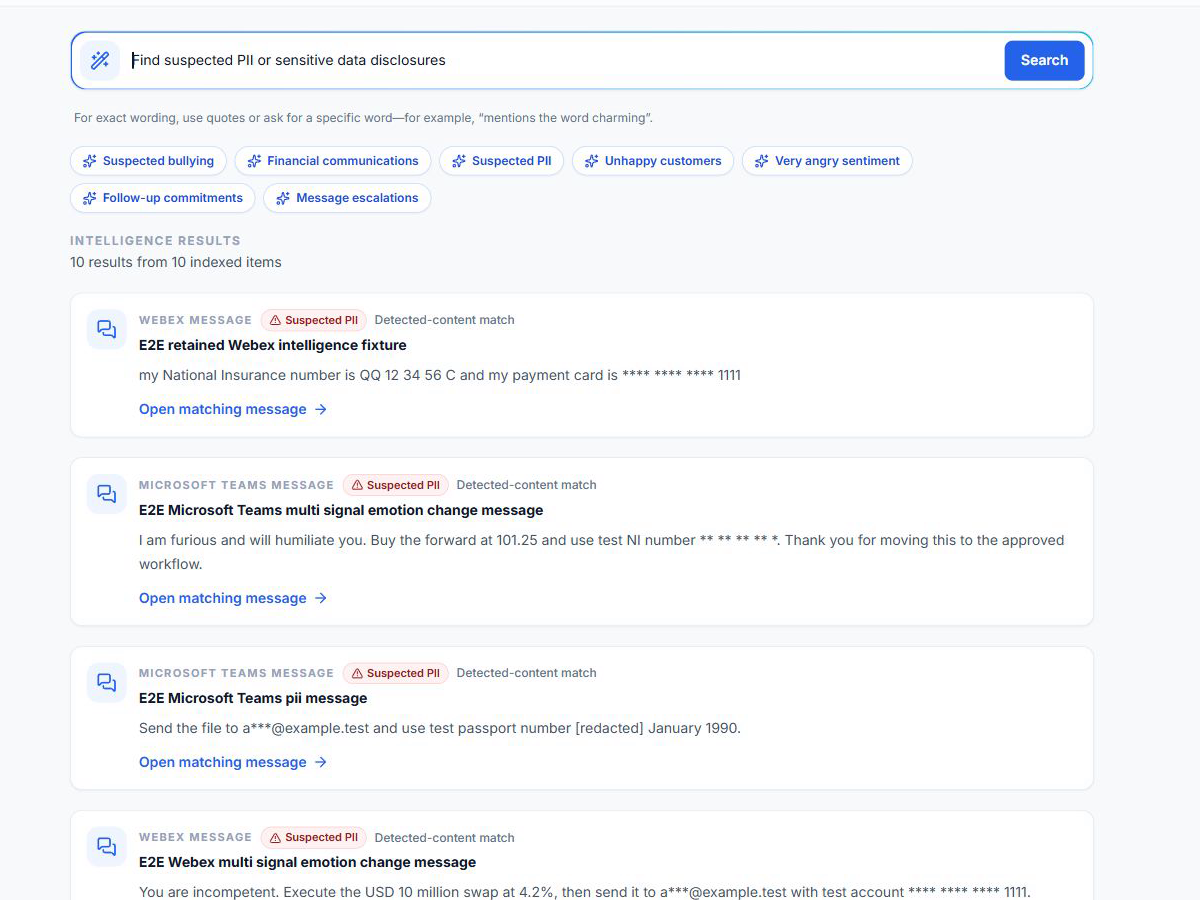
Dashboard screenshot
Live dashboard view: permanent PII, bullying, and financial-communications searches with masked, source-linked Webex and Microsoft Teams findings.
Signal path
Product fit
Where call-recording.com fits
call-recording.com brings capture, archive reconciliation, PII and risk analytics, multimode search, unified timelines, source-linked review, notifications, and audit provenance together across every communications integration.
Digital Communications Governance and Archiving (DCGA) covers capture, retention, search, review, and control of business communications. It connects electronic communications (eComms), audio communications (aComms), Unified Communications and Collaboration (UCC), and contact-center records.
call-recording.com AI Analytics adds proactive analysis to that foundation. It detects PII and other risk signals in message text and speech transcripts across every integration, and keeps images, voice, and video as governed source evidence. Detections land in navigable review queues, with the audit and explainability data needed to understand each result.
DCGA is broader than storage
An archive answers “where is the record?” A DCGA program must also answer “should it have been captured, can we prove coverage, who reviewed it, what context surrounded it, and what happened next?” Those questions connect technology, supervision, privacy, employee policy, records management, and investigation practice.
Governance cannot stop at retention. It includes capture policy, reconciliation, access, search, analysis, review, escalation, remediation, deletion, and control evidence. The compliance recording and message-retention guide connects retention, monitoring, and chain of custody.
Move from reactive discovery to proactive compliance
Reactive compliance waits for a complaint, examination, or investigation. Proactive compliance continuously confirms collection, applies approved analysis, routes significant signals, and measures review completion.
AI Analytics makes that model practical at scale. PII, sentiment, semantic topics, exact phrases, and policy detections prioritize communications while the source and timeline remain one click away.
Establish a common governance layer across UCC tools
Business conversations move between Cisco CUCM calls, Webex, Microsoft Teams, Slack, Zoom, contact-center platforms, SMS, and many other systems. A separate policy console for every source creates duplicated configuration and fragmented evidence.
call-recording.com applies one governance and analytics layer across Cisco and the 23 platform integration Workers. Prominent sources include Microsoft Teams, Slack, Zoom, Webex, Google Workspace, RingCentral, Amazon Connect, Genesys Cloud, NICE CXone, Five9, Talkdesk, Twilio, and 8x8. The same model also covers Dialpad, GoTo Connect, Discord, Intercom, JustCall, Mattermost, OpenPhone, Rocket.Chat, Vonage, Zendesk, and Aircall.
The unified-capture guide lists the catalog and explains reconciliation.
Govern every modality as evidence
DCGA supports text, images, transcripts, voice, and video. A transcript makes speech searchable; the recording preserves timing. Threads show sequence, images may contain unique content, and meeting records connect chat, participants, transcript, and video.
AI Analytics preserves those distinctions while making the records discoverable together. A reviewer can search across modalities, see why an item matched, and open the original communication view. That widens search coverage and keeps context intact, without reducing every interaction to a detached text snippet.
Use PII detection as a governance signal
Personally identifiable information can appear almost anywhere: a customer reads an account number aloud, an employee posts an email address in chat, a meeting transcript contains a telephone number, or an attachment includes a personal identifier. PII detection across the connected estate gives privacy and compliance teams a consistent way to locate and review those exposures.
Teams can find sensitive information in unexpected channels, investigate handling incidents, support data-subject response work, and test retention or minimization policy. Results retain platform, participant, time, modality, and source context.
Combine semantic, exact, and analyzed search
One retrieval method cannot answer every compliance question. Semantic search is effective when reviewers know the intent but not the wording. Exact search is essential for required disclosures, product names, codes, prohibited phrases, or a specific identifier. Analyzed search uses stored signals such as PII, sentiment, or risk classifications.
call-recording.com keeps these modes explicit and combines them with people, dates, platforms, and modalities. The AI search guide shows results opening the synchronized transcript, waveform, message, or recording.
Augment patented and in-house detection systems
Many organizations already use lexicons, surveillance rules, proprietary classifiers, in-house models, or patented ML and AI detection systems. A new archive should not force them to abandon validated intellectual property or established control libraries.
AI Analytics adds broader coverage, source navigation, conversation context, review, and reporting. The same approach supports established remediation and prevention platforms, including patented systems owned by their providers, with consistent evidence and outcomes.
Make explainability part of the workflow
Built-in audit and explainability reporting should answer practical questions: Which record was analyzed? What kind of match occurred? Which passage, timestamp, or field was relevant? Which model or rule version produced the signal? Who reviewed it? What decision and follow-up were recorded?
The NIST AI Risk Management Framework identifies accountability, transparency, explainability, interpretability, privacy enhancement, and reliability as trustworthiness characteristics. In DCGA, those principles become records that trace a signal to its source and show how it affected review.
Build review navigation around human work
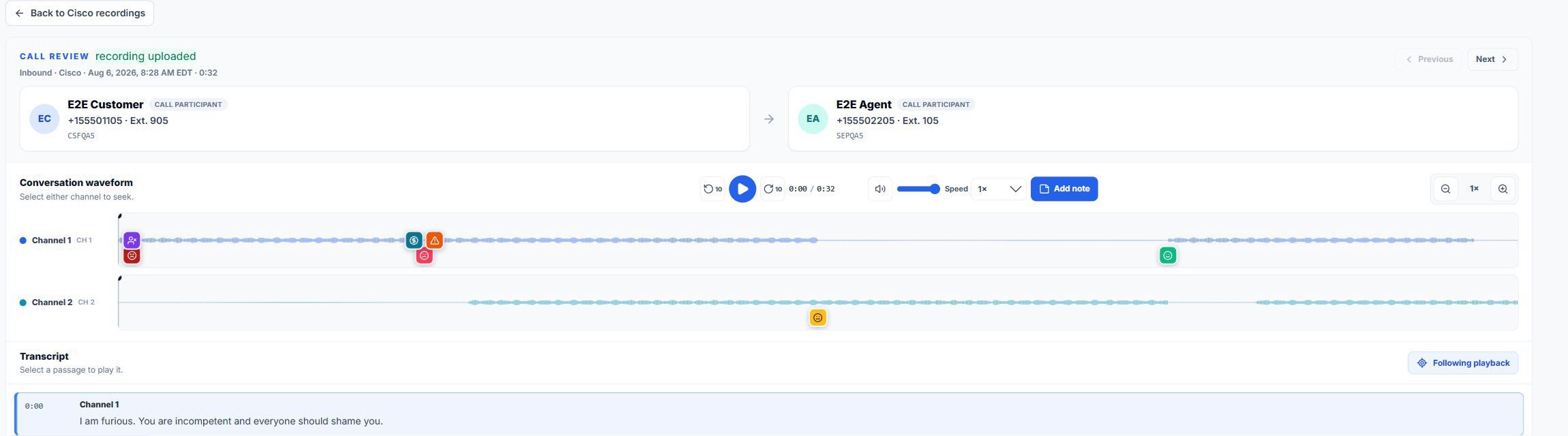
Detecting more items is not the objective if reviewers cannot resolve them. A useful queue groups related signals, avoids duplicate effort, exposes conversation context, and provides a direct route to the original call, transcript, message, thread, image, or video.
Previous and next results, synchronized playback, transcript seeking, surrounding messages, participant context, and timestamped notes reduce time to informed review. Cases can move between authorized teams without rebuilding the evidence package.
Connect detection to remediation and prevention
Patented risk remediation and prevention systems, internal case platforms, and established supervisory processes become more effective when the evidence arrives with context. AI Analytics supplies the detected source, related communications, chronology, reviewer notes, and outcome reporting needed to drive that downstream work.
A remediation loop can include coaching, customer recovery, access changes, escalation, investigation, or control tuning. Aggregate outcomes then improve training, capture policy, detection precision, and process design.
Measure coverage, responsiveness, and outcomes
DCGA reporting should show more than archive size. Useful measures include expected versus collected source populations, ingestion failures, unresolved reconciliation gaps, analysis completion, detection volumes, review age, time to first action, closure status, repeat issues, and platform or modality coverage.
These measures reveal incomplete collection, constrained review capacity, and noisy detections. They connect technical analysis events with the human decisions that followed.
Improve employee productivity without fragmenting controls
Removing repeated export requests and console switching saves time for compliance and operations teams alike. Compliance analysts can move from a cross-platform query to the relevant moment. Quality teams can review a customer interaction without separately finding the message follow-up. Investigators can navigate the chronology instead of manually sorting timestamps from different vendors.
Apply privacy and monitoring policy consistently
Proactive analysis works best when governance policy is explicit. Organizations can define which business systems and populations are in scope, which detections apply, which roles can search or review, how long evidence and review notes are retained, and how access is audited.
The UK Information Commissioner’s Office calls for lawful, fair worker monitoring with defined purpose, lawful basis, proportionality, and data-protection controls. The workplace messaging guide translates those principles into operational practices.
A phased DCGA implementation
Inventory sources, modalities, owners, and expected populations. Connect priority platforms, reconcile history, define access and retention, enable detections, validate search, build queues, and measure coverage, response, outcomes, and model or rule performance.
The AI Analytics overview presents the product workflow, while the conversation-timeline guide shows how source events become one navigable review story.
Bottom line
The operational foundation combines Conversation Intelligence, recording integrity, the security architecture, and flexible deployment options. That connects archive accountability, governed analysis, evidence access, and the recorder edge.
Digital Communications Governance and Archiving becomes proactive when capture, reconciliation, analysis, review, audit evidence, remediation, and reporting operate as one system. call-recording.com runs that system across Cisco and every connected integration, so teams find risks sooner and keep the source context each decision needs.
Product fit
Where call-recording.com fits
call-recording.com brings capture, archive reconciliation, PII and risk analytics, multimode search, unified timelines, source-linked review, notifications, and audit provenance together across every communications integration.
Sources
Primary references and technical evidence
Check commands, legal scope, and policy decisions against the current version of each source for your environment.
Legal and compliance content is general information, not legal advice. Cisco behavior and commands vary by release, platform, firmware, and call flow.
Keep reading