Cross-platform review
Unify Cisco, Teams, Slack, Zoom, and Webex Conversation Timelines for Compliance Review
How reviewers can rebuild a business conversation across calls, meetings, chats, transcripts, voice, and video without switching between separate vendor archives.
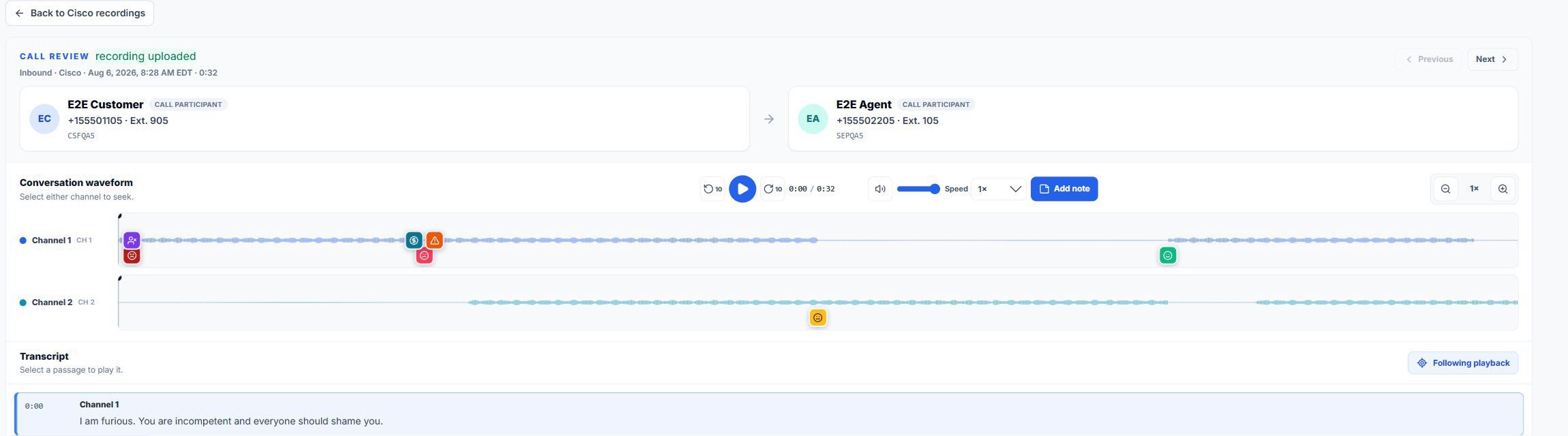
Dashboard screenshot
Live dashboard view using synthetic data: suspected bullying, regulated-finance, PII, and emotion markers align to the original dual-channel recording.
Signal path
Product fit
Where call-recording.com fits
call-recording.com links calls, meetings, messages, transcripts, participants, channels, detections, and review notes across every integration so authorized teams can navigate one conversation timeline and open the original source evidence.
A conversation rarely stays in one application. A customer may call through Cisco, receive a Teams follow-up, join Zoom, continue in Slack, and finish in Webex. Separate archives show fragments.
call-recording.com AI Analytics creates unified conversation views across UCC tools. It connects source-aware records into navigable timelines, applies PII and risk analysis across modalities, and lets reviewers move from a detection to the original call, message, transcript, image, voice, or video evidence.
The real unit of review is the conversation
Communication systems organize data around calls, meetings, channels, threads, recordings, or messages. Compliance work is organized around a customer complaint, trade discussion, conduct concern, disclosure, promise, or investigation.
A unified timeline keeps source objects intact while presenting the chronology of people and topics.
Why platform-by-platform review loses context
Separate archives force analysts to repeat searches, convert time zones, request exports, and manually sort results. Replies, edits, attachments, and follow-up calls can disappear from the sequence.
A risk detection also changes meaning beside nearby evidence: the previous message, next call, or meeting transcript may explain who introduced the subject. Context determines whether a match is useful.
Start with a source-aware event model
Unified conversation views require a common set of fields: organization, source platform, source identifier, conversation or meeting identifier, participants, timestamps, direction, modality, content location, and analysis state. These fields make cross-platform search possible.
Platform context must remain. A Slack reply, Teams post, Cisco call leg, Zoom Phone recording, and Webex message are not identical. Native identifiers and relationships route reviewers back to evidence and support reconciliation.
Follow one interaction across five major platforms
Consider a Cisco CUCM call followed by a Teams assignment, Slack discussion, Zoom customer meeting, and Webex confirmation.
The unified timeline can present those events in sequence:
- Cisco call recording, transcript, participants, and detected promise.
- Teams chat or channel activity that assigns the follow-up.
- Slack thread containing internal context and an attachment.
- Zoom meeting or Phone recording with transcript and participant details.
- Webex message or recording that confirms the outcome.
The reviewer moves along one chronology while every item retains its platform and modality.
Expand the same model across the integration estate
The timeline approach is not limited to five brands. call-recording.com applies the same analytics and review model across all 23 integration Worker platforms plus Cisco and the bespoke Webex integration. That includes 8x8, Aircall, Amazon Connect, Dialpad, Discord, Five9, Genesys Cloud, GoTo Connect, Google Workspace, Intercom, JustCall, Mattermost, Microsoft Teams, NICE CXone, OpenPhone, RingCentral, Rocket.Chat, Slack, Talkdesk, Twilio, Vonage, Zendesk, and Zoom.
The unified compliance-capture guide maps every platform to its recording or messaging modalities and explains archive connector reconciliation.
Reconcile history before trusting the timeline
A timeline needs an accounted source population. History and live collection require durable identifiers, windows, continuation state, retries, duplicate control, and failure visibility. Reconciliation distinguishes silence from incomplete collection.
call-recording.com connects to existing eComms and aComms systems as a reconciling archive connector, combining imported history with ongoing capture. The recording integrity page applies the same principle to locally captured media.
Keep text, images, transcripts, voice, and video together
A conversation can contain text, images, attachments, transcripts, voice, and video. Each adds wording, structure, searchable speech, timing, or meeting context.
One result can identify a transcript passage, seek the recording, show an attachment, and place both beside surrounding messages. Covering every modality widens search and keeps context intact.
Overlay PII detection on the chronology
PII detection becomes more informative when it is viewed over time. A personal identifier may first appear in a call, be copied into a Teams message, included in a Slack attachment, repeated during a Zoom meeting, and corrected in Webex. Isolated alerts show five items; a unified timeline shows one propagation path.
AI Analytics records PII signals against source communications for privacy review, handling investigations, retention decisions, and process improvement without losing chronology.
Combine risk signals with exact and semantic search
Conversation review needs more than one search method. Semantic search finds meaning across natural variations, such as a promise to call back expressed in different words. Exact search locates a required disclosure, account code, name, or prohibited phrase. Analyzed search filters for PII, sentiment, or another recorded detection.
A reviewer can search for a cancellation, require an exact product name, filter to negative sentiment, and inspect calls and messages. The AI search guide shows results opening at the relevant transcript, waveform, or message.
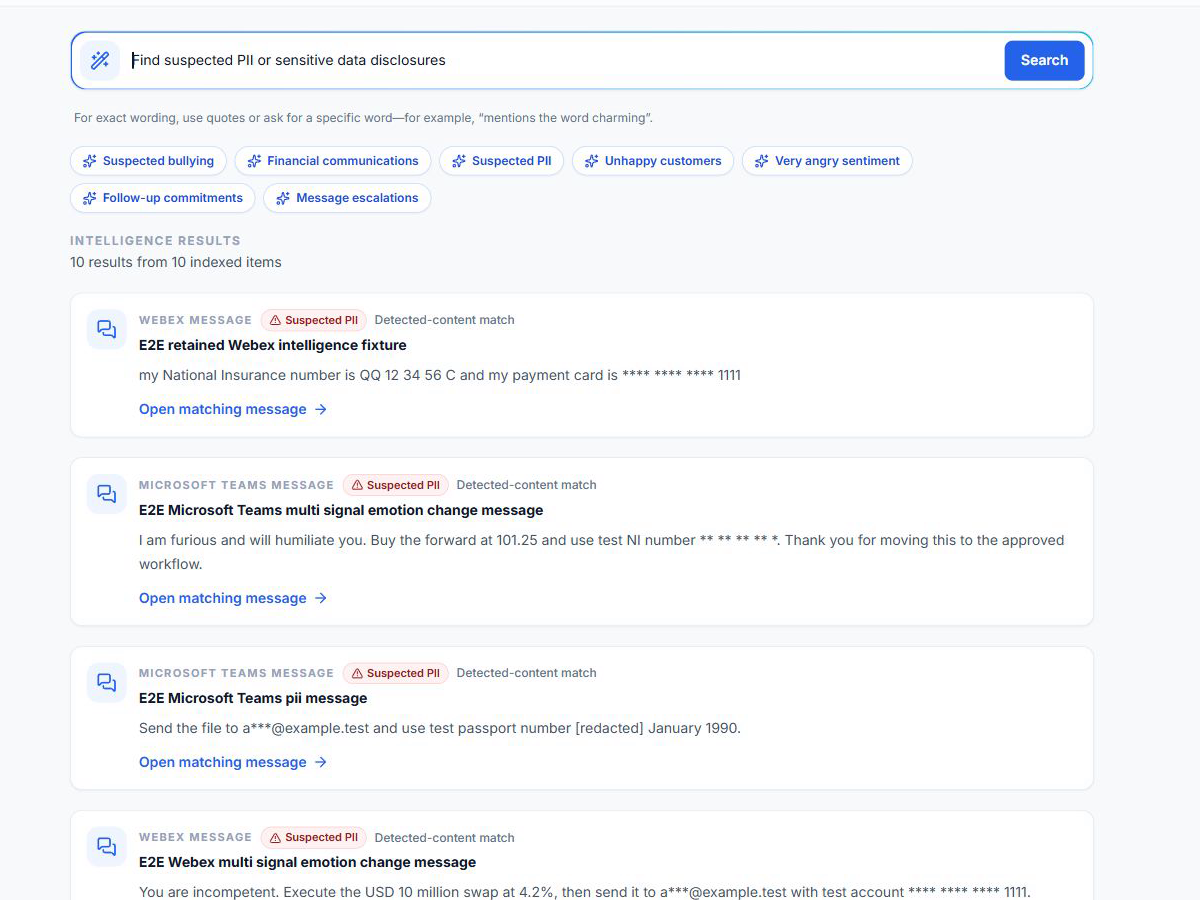
Navigate from detection to evidence
A detection queue should lead to the call workbench, synchronized transcript, surrounding thread, meeting, or attachment. Navigation, timestamped notes, participant details, waveform seeking, and focused messages make verification efficient.
That is where the time savings come from. Instead of copying an identifier into several consoles, the reviewer follows the timeline, inspects the relevant moment, records the outcome, and continues to the next connected event.
Augment established surveillance and remediation tools
Organizations may already have policy rules, lexicons, in-house classifiers, patented ML and AI detection systems, or patented risk-remediation and prevention platforms supplied by other vendors. Unified conversation timelines can augment those investments by adding cross-platform source navigation and a consistent evidence layer.
Existing detections can point into call-recording.com. Outcomes, notes, and chronology then support established case, remediation, reporting, and prevention workflows alongside patented methods owned by their respective providers.
Preserve audit and explainability evidence
Built-in audit and explainability reporting shows source, analysis status, match type, relevant passage, model or rule context, reviewer activity, decision, follow-up, and the connected events available during review.
NIST describes transparency, explainability, and interpretability as related trustworthiness characteristics. A source-linked timeline turns them into review evidence.
Improve compliance and employee productivity
Unified timelines save time across teams because they cut repetitive evidence assembly. Compliance analysts resolve alerts faster. Privacy teams can trace sensitive data across channels. Quality teams can connect a difficult call with the follow-up that resolved it. Employee-relations reviewers can assess a sequence instead of a single message. Engineers can diagnose capture gaps with source identifiers already attached.
Build proactive compliance around conversation views
Proactive compliance reconciles sources, applies approved detections, routes conversations, measures review aging, and identifies repeated patterns. Outcomes reveal process issues, training needs, recurring complaints, or weak capture points.
This is a core Digital Communications Governance and Archiving capability. The DCGA and proactive AI Analytics guide explains how capture, analysis, review, remediation, prevention, and reporting form one operating loop.
A practical review workflow
Confirm the result’s source and match type, open the original, expand nearby events, review participants and modalities, add timestamped notes, record the disposition, route follow-up, and close the item with its audit trail.
The AI Analytics overview brings this workflow together across Cisco, Teams, Slack, Zoom, Webex, and the complete integration Worker catalog.
Bottom line
Unified review draws on Conversation Intelligence, accountable recording integrity, the security architecture, and flexible recorder deployment. Those layers keep the route from capture to timeline to source evidence coherent.
Compliance review is faster and more accurate when the archive presents the conversation instead of a pile of unrelated platform records. call-recording.com brings conversation timelines, multimodal evidence, PII and risk signals grounded in text and transcripts, exact and semantic search, source navigation, and explainability reporting together across the UCC estate, so reviewers can see what happened, where, and what came next.
Product fit
Where call-recording.com fits
call-recording.com links calls, meetings, messages, transcripts, participants, channels, detections, and review notes across every integration so authorized teams can navigate one conversation timeline and open the original source evidence.
Sources
Primary references and technical evidence
Check commands, legal scope, and policy decisions against the current version of each source for your environment.
Legal and compliance content is general information, not legal advice. Cisco behavior and commands vary by release, platform, firmware, and call flow.
Keep reading