Unified compliance capture
How call-recording.com AI Analytics Ensures Unified Compliance Capture
How one capture and analytics layer spans every integration and communications type, reconciles existing archives, and makes the whole conversation reviewable.
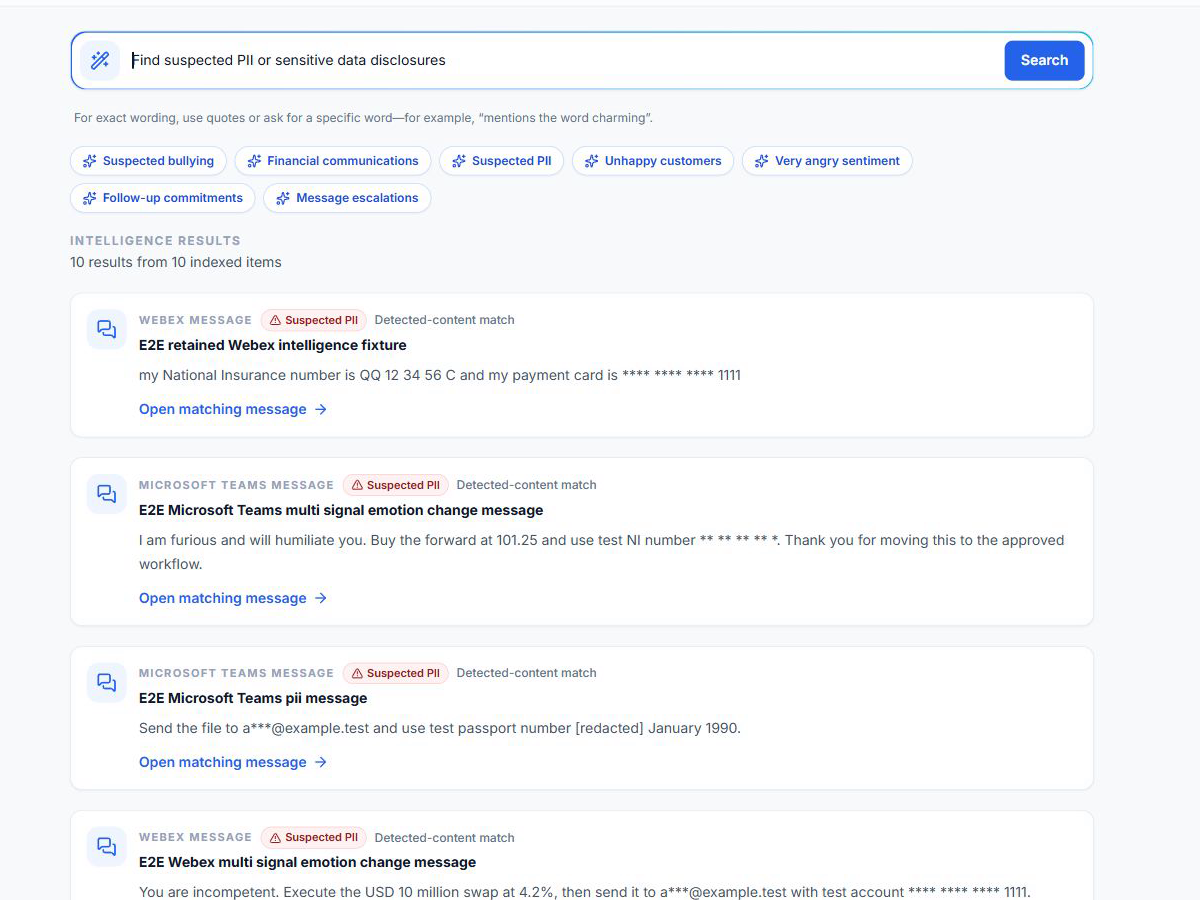
Dashboard screenshot
Live dashboard view: permanent PII, bullying, and financial-communications searches with masked, source-linked Webex and Microsoft Teams findings.
Signal path
Product fit
Where call-recording.com fits
call-recording.com unifies capture and AI analytics across Cisco CUCM, Webex, Microsoft Teams, Slack, Zoom, and every other integration, linking retained text, images, transcripts, voice, and video into one searchable, source-linked conversation record.
Compliance evidence is divided among voice platforms, meeting systems, contact centers, workplace chat, SMS, transcripts, images, and video. A search in one tool can miss the continuation in another.
call-recording.com AI Analytics brings those records into one governed analysis experience. It unifies compliance capture across platforms, reconciles imported populations, detects personally identifiable information (PII), and gives reviewers a faster route from a risk signal to the original conversation and its context.
Why unified compliance capture matters
A communication policy is only as effective as its coverage. A recorded Cisco call may be followed by a Microsoft Teams message, Slack thread, Zoom meeting, or Webex exchange. Separate archives make basic questions difficult: Was the conversation captured? Did it change channel? What surrounded the detected phrase?
One control plane for eComms and aComms
Digital Communications Governance and Archiving (DCGA) brings electronic communications (eComms) and audio communications (aComms) into the same operating model. The distinction still matters: a message edit is not the same event as a spoken sentence, and a video recording is not merely a large text attachment. The governance layer must support every modality while making them discoverable together.
call-recording.com provides that shared control plane. Authorized teams can search captured communications, inspect native evidence, follow activity, record outcomes, and report from one service. The result is broader search coverage and faster response.
An archive connector with reconciliation
The platform can act as an archive connector with reconciliation for existing eComms and aComms infrastructure. That means an organization can connect current communications systems, import available history, continue receiving new activity, and compare expected source populations with the records that reached the archive.
Reconciliation tracks source identifiers, import windows, continuation state, retries, duplicates, updates, deletions, and failed retrieval. It distinguishes “nothing happened” from “collection is incomplete.” The recording integrity architecture applies the same accountability principle to captured media delivery.
Support every important modality
The AI Analytics layer supports communications from text and images to transcripts, voice, and video recordings. Each modality contributes different evidence:
- Text preserves wording, threads, edits, reactions, mentions, and channel context.
- Images and attachments can contain identifiers, screenshots, and documents.
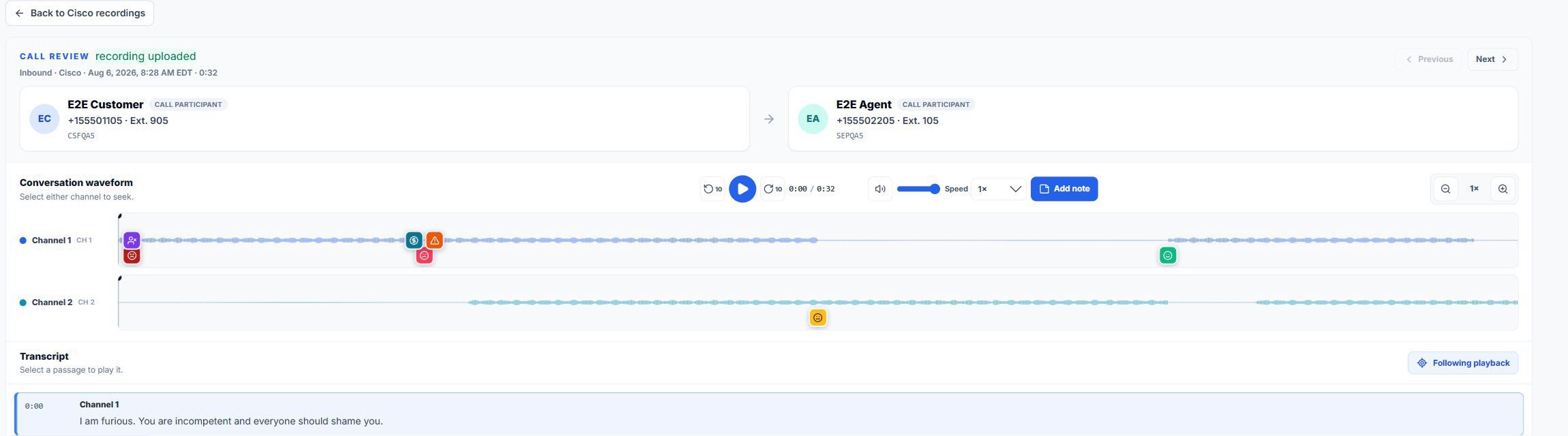
- Transcripts make speech searchable and link back to the recording.
- Voice preserves timing, interruption, and the original exchange.
- Video connects spoken content with the wider meeting event.
Review does not stop at a summary. Search results lead back to the source item, synchronized transcript, recording workbench, conversation view, or platform timeline needed to verify the finding.
The complete integration Worker catalog
Cisco CUCM recording and the bespoke Webex integration sit alongside 23 dedicated integration Workers. Together they cover major unified communications, contact-center, voice, meeting, and messaging platforms.
| Platform | Captured communications |
|---|---|
| 8x8 | Work and Contact Center call recordings |
| Aircall | Call recordings and call metadata |
| Amazon Connect | Contact recordings and chat transcripts |
| Dialpad | Call recordings, transcripts, and SMS history |
| Discord | Server message history |
| Five9 | Contact-center call recordings |
| Genesys Cloud | Interaction recordings and message transcripts |
| GoTo Connect | Call recordings and meeting content |
| Google Workspace | Google Meet recordings and Google Chat history |
| Intercom | Conversation history |
| JustCall | Call recordings and SMS history |
| Mattermost | Channel and direct-message history |
| Microsoft Teams | Meeting recordings, call records, chats, channel posts, and replies |
| NICE CXone | Contact-center call recordings |
| OpenPhone | Call recordings and text-message history |
| RingCentral | Call recordings, SMS, and team messaging history |
| Rocket.Chat | Channel and direct-message history |
| Slack | Workspace messages, threads, and files |
| Talkdesk | Contact-center call recordings |
| Twilio | Call recordings, SMS, and Conversations history |
| Vonage | Business Communications call recordings and messages |
| Zendesk | Talk call recordings and messaging history |
| Zoom | Meetings and Phone recordings plus Team Chat history |
This breadth lets a compliance program start with prominent systems such as Cisco, Microsoft Teams, Slack, Zoom, and Webex while using the same analysis and review model across every connected platform.
Normalize records without flattening evidence
Unified does not mean indistinguishable. The system normalizes the fields needed for cross-platform discovery—organization, source, participants, timestamps, conversation identifiers, modality, content, and analysis state—while keeping the identifiers and relationships that explain where an item came from.
Detect PII across the communications estate
PII detection is most valuable when applied consistently. Personal data can appear in a transcript, chat, SMS exchange, attachment, meeting, or voice interaction. One-platform detection leaves predictable gaps.
call-recording.com AI Analytics applies PII analysis across connected communications and records the resulting signals with the source item. Reviewers can find where sensitive information appears, open the surrounding exchange, and use the result in privacy, data-handling, quality, or incident workflows. The GDPR call-recording guide explains why purpose, minimization, access, retention, and security belong in the same program.
Improve compliance search coverage and responsiveness
The search experience combines semantic intent, analyzed signals, and exact wording. A reviewer can look for a topic or promise in ordinary language, filter for a detection such as PII or negative sentiment, or require a literal term when the exact phrase matters.
Semantic retrieval finds relevant variations. Exact search keeps named disclosures, identifiers, and required phrases literal. Detection filters narrow the population before review. The AI search guide shows these modes opening synchronized call and message evidence.
Navigate timelines and unified conversation views
Unified conversation timelines connect calls, meetings, messages, threads, transcripts, and follow-up activity. Reviewers move from a detection to nearby events instead of rebuilding chronology from exports.
The dedicated guide to unified Cisco, Teams, Slack, Zoom, and Webex conversation timelines explains how this view improves investigation speed and preserves channel context.
Augment existing detection and remediation systems
AI Analytics can augment existing detections rather than forcing an organization to discard working controls. A firm can combine call-recording.com signals with rules, lexicons, in-house models, or patented ML and AI detection systems already used for supervision. It can likewise feed review outcomes into established risk-remediation and prevention workflows, including systems built around patented methods owned by their respective providers.
Built-in audit and explainability reporting
A detection needs an evidence trail. Built-in reporting records the analyzed source, signal, processing time, review activity, status, finding, and follow-up.
This aligns with the NIST AI Risk Management Framework. Operational explainability shows the source, match type, relevant passage or time, model or rule context, and review history.
Save time for compliance and operations teams
Unified capture reduces duplicated work. Compliance teams spend less time requesting exports, switching consoles, rebuilding timelines, and searching the same names repeatedly. Employees responsible for quality, customer care, investigations, legal response, and operational coaching can reach the relevant moment faster.
A practical rollout sequence
A rollout begins with the communication inventory and expected population. Connect priority systems, reconcile history, verify new events, test each modality, enable detections, define queues, and establish audit reporting.
The AI Analytics landing page brings those capabilities together. Organizations can expand from Cisco, Webex, Teams, Slack, and Zoom to the rest of the integration catalog without rebuilding the governance model for each platform.
Bottom line
The analytics layer works with Conversation Intelligence, recording integrity, the security architecture, and flexible recorder deployment options. Together they connect captured evidence, accountable delivery, authorized analysis, and review.
Unified compliance capture means more than a larger search index: a reconciled, source-aware archive for voice, video, transcripts, text, images, and attachments; an AI analysis layer grounded in message text and speech transcripts; and a review experience that preserves the original communication. call-recording.com turns that model into one operational workflow across Cisco and every integration Worker.
Product fit
Where call-recording.com fits
call-recording.com unifies capture and AI analytics across Cisco CUCM, Webex, Microsoft Teams, Slack, Zoom, and every other integration, linking retained text, images, transcripts, voice, and video into one searchable, source-linked conversation record.
Sources
Primary references and technical evidence
Check commands, legal scope, and policy decisions against the current version of each source for your environment.
Legal and compliance content is general information, not legal advice. Cisco behavior and commands vary by release, platform, firmware, and call flow.
Keep reading