Call recording fundamentals field guide
What Is Call Recording? A Guide for Businesses Using Cisco Telephony
A plain-English definition of call recording that narrows into the real architecture, policy, and operational decisions facing businesses on Cisco CUCM, UCCX, Finesse, CUBE, and Webex.
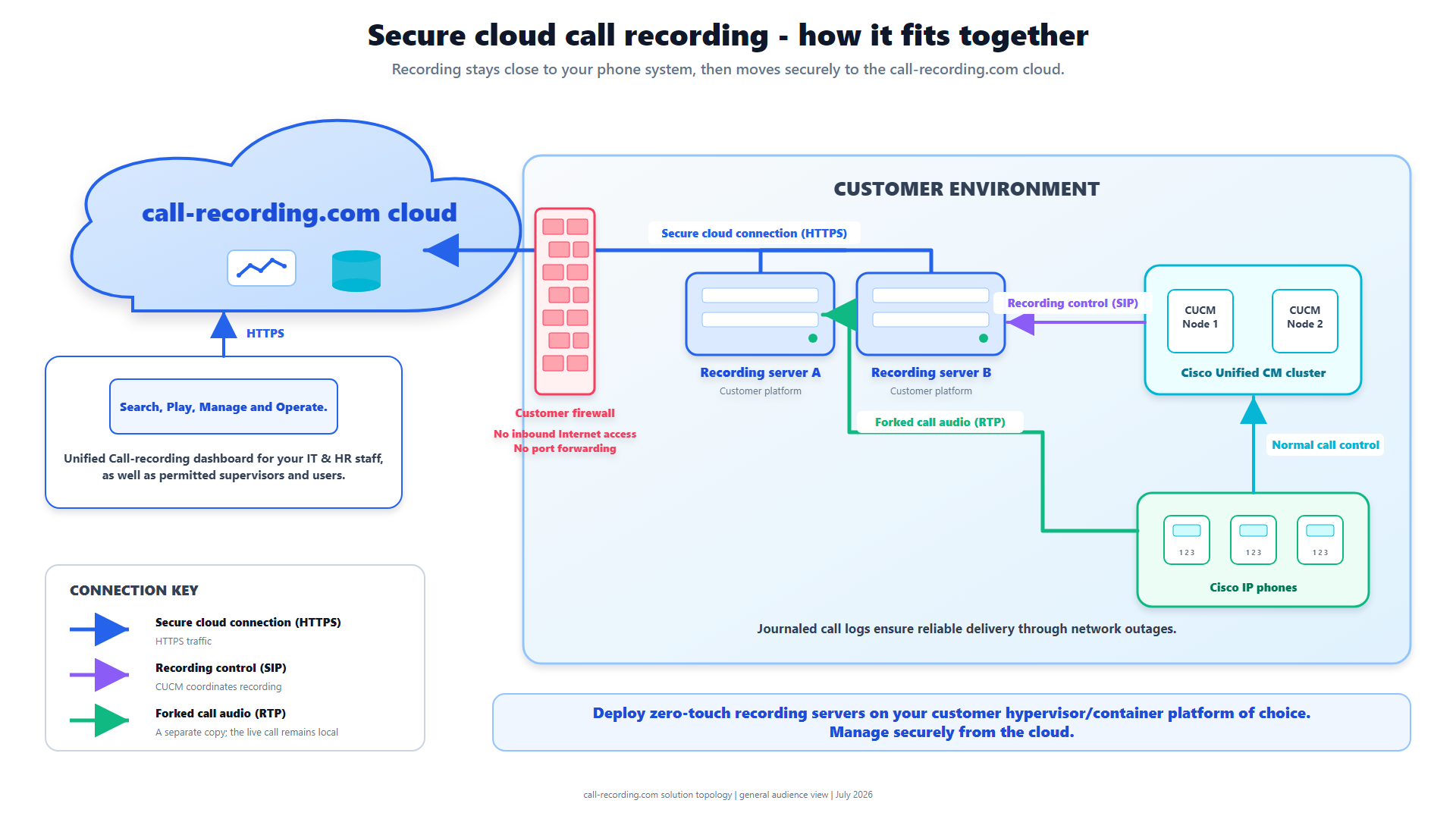
Signal path
Where call-recording.com intervenes
From technical requirement to working recording
call-recording.com packages Cisco call capture, a customer-hosted recorder, guided provisioning, encrypted storage, recording search, retention, and delivery accountability into one self-service service.
What is call recording?
Call recording is the controlled capture, storage, and management of the audio and contextual information from a telephone or voice conversation. A complete business call-recording system does more than create an audio file: it decides which calls to capture, receives both sides of the conversation, associates the audio with useful call details, protects the recording, makes it searchable, retains it for the right period, and proves whether delivery succeeded.
That definition covers everything from a person pressing Record in an application to an enterprise system recording thousands of regulated or customer-service calls. The difference is not merely scale. Business recording requires consistent policy, security, retrieval, retention, resilience, and accountability.
What information does a recording system capture?
The primary content is audio, usually one or more media streams representing the participants. A useful recording record also includes metadata such as:
- caller and called numbers;
- user, extension, and device identity;
- inbound, outbound, or internal direction;
- start, answer, and end times;
- call and session identifiers;
- platform and recording source;
- transfer, hold, conference, or segment relationships;
- delivery, retention, and processing state.
Cisco Call Detail Records contain valuable call metadata, but they do not contain the audio. The CUCM CDR guide explains that distinction. call-recording.com joins the audio workflow with searchable call context so a business does not have to manage two unrelated archives.
Why businesses record calls
Businesses use call recording for different purposes:
- evidence of customer instructions or transactions;
- regulatory recordkeeping;
- dispute resolution;
- quality assurance and coaching;
- contact-center supervision;
- safety, fraud, or security investigations;
- service improvement;
- documentation of verbal agreements;
- continuity when case notes are incomplete.
Each purpose creates a different scope and retention decision. A financial trading desk, healthcare appointment line, sales team, and emergency service should not inherit the same policy simply because all use phones.
call-recording.com lets a Cisco business define the intended users and recording path while applying common security, search, delivery, and retention controls.
The five stages of business call recording
A reliable system has five connected stages:
- Policy: decide which calls should be recorded and why.
- Capture: fork or receive the audio at a Cisco endpoint, border, platform, or application.
- Processing: correlate streams and metadata into a usable recording.
- Protection and delivery: encrypt, journal, upload, confirm, and monitor the recording.
- Use and disposition: search, play, export, retain, place on hold, or delete according to policy.
A failure in any stage can make the recording unusable. Perfect audio without a caller or timestamp is difficult to retrieve. Complete metadata without audio is not a recording. An uploaded file without access controls creates risk. A retention rule without confirmed capture creates false confidence.
How Cisco CUCM records calls
Cisco Unified Communications Manager can invoke recording for configured line appearances. In a common design, a supported Cisco phone uses its Built-In Bridge to fork the incoming and outgoing media streams. CUCM establishes recording calls toward a recording server through a configured recording profile and SIP routing path.
This model provides per-line automatic or selective recording control. It also means phone support, firmware, Built-In Bridge settings, recording profiles, route patterns, calling search spaces, codecs, notification tones, and real call features must be correct.
The Cisco Built-In Bridge guide covers those details. With call-recording.com self-service deployment, the guided setup automates the Cisco work and validates the path so the business does not have to build it object by object.
How Cisco CUBE records with SIPREC
SIPREC moves the recording point from the phone to the session border. Cisco CUBE acts as a Session Recording Client, creates a recording session toward a recorder, and sends forked RTP plus structured metadata.
This can be effective for calls that consistently traverse CUBE, including SIP trunk traffic and centralized edge call flows. It may also cover endpoint types that do not provide Cisco BIB. The boundary is equally important: internal or alternate-path calls that never traverse the selected CUBE path are not magically included.
Read SIPREC and Cisco CUBE call recording for configuration, restrictions, and testing.
Call recording in UCCX, Finesse, and contact centers
Contact centers add agent state, queues, transfers, supervisors, wrap-up, and customer context. The audio still follows an underlying media path, but the business often expects recordings to be found by agent, team, queue, direction, or customer interaction.
A design should test:
- inbound queue calls;
- consult and blind transfers;
- agent-to-agent calls;
- conferences;
- hold and resume;
- extension mobility and shared devices;
- supervisor monitoring and barge;
- remote agents;
- calls that leave or re-enter the contact center.
call-recording.com is built around Cisco business environments rather than a generic browser microphone. Its recorder and cloud workflow are designed to turn Cisco call media into searchable organizational records.
No time to waste translating raw call detail records? Use Call Recordings FREE tool below!
CDR Clarity
Free from call-recording.com
The smarter way to view Call Records
Our free tool decodes Cisco CUCM call records into plain language and displays them in a beautiful "spreadsheet" inspired UI.
Open free CDR viewerOn-premises, cloud, and hybrid recording
“On-premises” and “cloud” describe management and storage, but capture still has to happen near the voice media.
| Model | Capture and management pattern |
|---|---|
| Traditional on-premises | Recorder, application, database, and storage run in customer facilities. |
| Cloud-native platform recording | The collaboration platform creates and stores the recording in its cloud. |
| Hybrid cloud recording | A lightweight customer recorder captures Cisco media locally and securely delivers recordings to a cloud management service. |
call-recording.com uses the hybrid model for customer-managed Cisco voice: local capture preserves access to the Cisco media path, while cloud management provides searchable access, retention, and service operation. Learn more in the cloud call recording guide.
What makes an enterprise recording usable?
Audio quality matters, but enterprise usability includes:
- both parties are audible and correctly synchronized;
- related call segments remain associated;
- participants and timestamps are accurate;
- recordings can be found without knowing a filename;
- access is limited to the correct organization and roles;
- recording delivery has an observable state;
- retention is automatic and documented;
- outages do not silently discard pending recordings;
- exports are controlled;
- the system can scale across users and sites.
These are the surrounding capabilities call-recording.com provides: not merely capture, but a complete Cisco recording architecture.
Security for business call recording
Recordings can contain payment details, confidential strategy, customer identity, regulated instructions, health information, and employee data. Treat them as sensitive records.
A sound architecture protects:
- the Cisco signaling and media path;
- the local recorder host and storage;
- the delivery connection;
- cloud recording storage;
- dashboard authentication and authorization;
- exports and administrative actions;
- retention and deletion.
call-recording.com encrypts recordings at rest on the local recorder host and in cloud storage, uses outbound HTTPS for delivery and management, and scopes access to the customer organization. The security architecture explains the network boundary.
Reliability: capture is not the same as delivery
Cloud connectivity can fail after a call is captured. A reliable recording system separates those states instead of treating a failed upload as a lost call.
The call-recording.com recorder uses local persistence and journaling to protect finished calls, retries delivery, and waits for cloud confirmation. Audio is not simply dropped because the WAN was unavailable at the end of the call.
That workflow is described in Recording Integrity. It is a major difference between a production recording service and a script that posts a file once.
Call recording law and disclosure
Recording laws vary by jurisdiction, parties, context, purpose, and sector. Some situations require consent or notice; some impose employee-monitoring requirements; regulated sectors may require recording and retention; privacy laws affect access, storage, and deletion.
Use the Guide to Call Recording Laws as a planning framework, then obtain legal advice for the actual call population. Cisco notification tones and announcements can help implement an approved notice policy, but the technology does not decide what the law requires.
How do you record a call on Cisco?
In a business Cisco environment, recording starts by selecting an authorized media path. Common choices include CUCM phone-based recording through Built-In Bridge, Cisco CUBE recording through SIPREC, or a supported Webex recording integration. The administrator configures the selected path toward a recorder, applies the organization's recording policy, and then validates representative calls.
That is different from installing a consumer mobile application or capturing a local microphone. Enterprise Cisco recording must receive the intended call media, preserve useful call context, restrict access, and prove what happened when capture or delivery fails.
For CUCM, begin with the Built-In Bridge guide. For border recording, use the CUBE SIPREC guide. For an overview across CUCM, UCCX, CUBE, and Webex, read the Cisco call recording software guide.
What software for call recording should a business choose?
Ask vendors to prove the whole lifecycle:
- Which Cisco platforms and recording methods are supported?
- How is CUCM or CUBE configured?
- Where does the recorder run?
- Are local recordings encrypted at rest?
- What happens during a cloud outage?
- How is successful delivery confirmed?
- Which inbound firewall ports are required?
- How are users and organizations isolated?
- Can retention be configured?
- Can calls be searched by useful Cisco details?
- How are upgrades, monitoring, and recorder health handled?
- Is pricing predictable per user?
call-recording.com answers those questions with guided Cisco provisioning, customer-hosted capture, outbound-only cloud communication, encrypted storage, journaled delivery, search, retention, and transparent pricing.
A concise definition for Cisco businesses
For a Cisco business, call recording is the policy-controlled capture of CUCM, UCCX, Finesse, CUBE, or Webex voice media plus the secure system that turns that media into a searchable, retained, and accountable business record.
The Cisco platform supplies the call and recording opportunity. call-recording.com supplies the self-service deployment, recorder, encrypted delivery lifecycle, cloud management, and predictable operating model.
Still struggling to decipher your call detail records? Try our user friendly tool!
CDR Clarity
Free from call-recording.com
The smarter way to view Call Records
Our free tool decodes Cisco CUCM call records into plain language and displays them in a beautiful "spreadsheet" inspired UI.
Open free CDR viewerWhere call-recording.com intervenes
From technical requirement to working recording
call-recording.com packages Cisco call capture, a customer-hosted recorder, guided provisioning, encrypted storage, recording search, retention, and delivery accountability into one self-service service.
Source ledger
Primary references and technical evidence
Validate version-specific commands, legal scope, and policy decisions against the current source applicable to your environment.
Legal and compliance content is general information, not legal advice. Cisco behavior and commands vary by product release, platform, firmware, and call flow.
Continue the research